|
 |



This week marked an important anniversary for the Institute of Economic Affairs. On 9 October 1974, the Royal Swedish Academy of Sciences issued a press release, announcing that they had “awarded the 1974 Prize for Economic Science in Memory of Alfred Nobel to Professor Gunnar Myrdal and Professor Friedrich von Hayek for their pioneering work in the theory of money and economic fluctuations and for their penetrating analysis of the interdependence of economic, social and institutional phenomena.”
Great for Hayek, but what does that have to do with the IEA, you may wonder?
Quite a lot, is the answer. Although Hayek never formally worked at the IEA, he was nonetheless one of the most significant figures in the institute’s history. If we had to name ourselves after a person, in the way our friends from the Adam Smith Institute do, we would undoubtedly be the Friedrich August von Hayek Institute. It was Hayek’s book The Road To Serfdom (1944) which ‘radicalised’ a young Antony Fisher, the future founder of the IEA. It was Hayek who personally dissuaded Fisher from his initial plan of becoming a politician, and who persuaded him to become an ‘ideas entrepreneur’ instead. It was Hayek’s model, outlined in The Intellectuals And Socialism (1949), of how major changes in the climate of opinion happen, which became the closest thing to a blueprint for the future IEA. Hayekian themes appear in almost every major IEA publication.
Hayek was, of course, also an IEA author in his own right. Last but not least, you can spot him in old photos taken at or around the institute, and you can find some of his letter correspondence with our predecessors in our archives.
Significant events in Hayek’s professional life are therefore, by extension, significant events in the history of the Institute of Economic Affairs as well.
The more important anniversary, though, will be 10 December, the day of the Nobel Prize award ceremony, when Hayek delivered his Nobel Prize lecture The Pretence of Knowledge. We plan to mark the occasion by republishing The Pretence of Knowledge in full, with introductions from three contemporary scholars steeped in Hayekian thought.
Kristian Niemietz
IEA Editorial Director
P.S. The best way to support our vital research and educational programmes is to become a paid IEA Insider. For a limited time, new paid subscribers will receive a copy of Steve Davies’ new book Apocalypse Next: The Economics of Global Catastrophic Risks and a 15% discount.
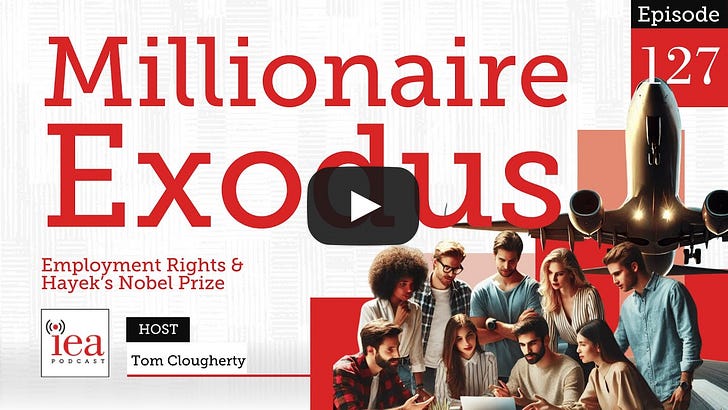
Why Britain is Losing its Best and Brightest, Employment Rights & Hayek's Nobel Prize | IEA Podcast, Executive Director Tom Clougherty, and Editorial Director Kristian Niemietz, with ASI Director of Research & Education Maxwell Marlow, IEA YouTube

Employment Rights Bill strengthens unions and undermines productivity
 |
Commenting on the Employment Rights Bill announced by the Government this week, IEA Editorial & Research Fellow Professor Len Shackleton said:
“It appears that the Employment Rights Bill is not going to be quite as game-changing as either the trade unions hoped or the business lobby feared.
“The creation of a nine-month probationary period – instead of a simple scrapping of the two-year wait for unfair dismissal law to kick in – may assuage some of the fears of businesses, but we will have to see how this shapes up in practice. The ability to dismiss during probation is likely to be tightly circumscribed.
“Enhanced eligibility for sick pay will result in some extra costs to both the taxpayer and employers, but the amounts involved are fairly small, while further adjustments to parental leave are unlikely to be generally of great significance but could hit some small businesses badly.
“The headline issue is flexible working rights. The right to request from Day One, and the tightening of grounds for refusal, could well land employers with significant extra costs – which for many businesses will come as a shock. Over time they will attempt to reduce these costs in various ways – by taking on fewer workers, by using temporary contracts rather than permanent workers, and by passing the costs on to employees in terms of lower pay than they would otherwise have received, or other detriments to the employment package.
“Employers will be relieved that there is as yet no planned compulsory Right to Disconnect, but this remains an issue on the horizon and is something to which Labour will probably return.
“What is particularly worrying is that the enhanced power of trade unions, linked with these new employment rights, will make it very difficult for ministers to pursue effective policies to improve the pitiful level of productivity in the public sector. This does not seem to figure in their thinking.”
Plan for workers' rights is a disaster for small businesses, Public Policy Fellow Matthew Lesh, Evening Standard
Unions gain strike powers under Rayner law, Len Shackleton quoted in The i, The Daily Mail, The North East Post, and The Yorkshire Times
News, Views & Upcoming Events
Britain is sliding towards an alcohol ban. Don’t say we weren’t warned, Head of Lifestyle Economics Christopher Snowdon, The Daily Telegraph
'Stop Banning Investment!' - Hard-Hitting Truths for UK Economic Growth, Executive Director Tom Clougherty, former IEA Head of Regulatory Affairs Victoria Hewson, Britain Remade Head of Policy Sam Dumitriu, Centre for Policy Studies Head of Tech & Innovation Matthew Feeney, and Keystone Consulting Director Fiona Cuthbertson, IEA YouTube
Reeves urged to scrap free prescriptions for 60 to 65 year olds, Editorial Director Kristian Niemietz, The Daily Telegraph, The Daily Express, and GB News
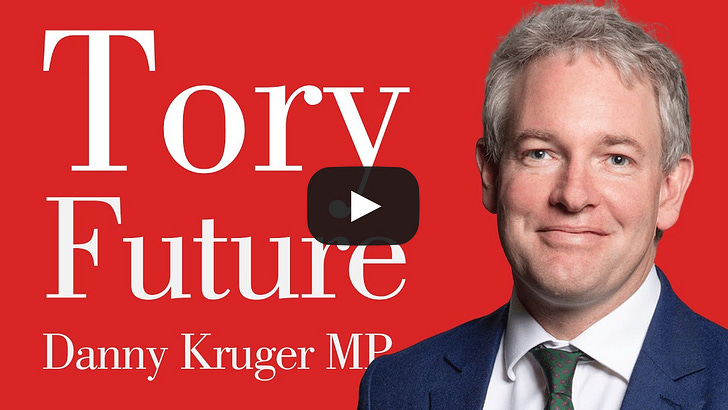
The Future of Conservatism: Danny Kruger MP on Family, Nation, and Free Markets, IEA YouTube
Capital gains tax must be paid by business founders who leave UK, Reeves told, IEA Economics Fellow Julian Jessop quoted in The i
Rachel Reeves considers a £17BILLION national insurance hit to employer pension contributions in Budget, Julian Jessop quoted in The Daily Mail
Measuring Marx: The Soviet Union and the rise of the Marxist intellectual, Economist Phillip W. Magness explains how the ideas of ‘little-known author of a panned and discarded book’ Karl Marx were catapulted to the forefront of academic debate by the Russian Revolution.
Measuring Marx | ||||||
| ||||||
 | ||||||
By Phillip W. Magness, David J. Theroux Chair in Political Economy at the Independent Institute. | ||||||
|
 | A guest post by
|
You’re currently a free subscriber to Insider. For the full experience, upgrade your subscription.
Paid subscribers support the IEA's charitable mission and receive special invites to exclusive events, including the thought-provoking IEA Book Club.
We are offering all new subscribers a special offer. For a limited time only, you will receive 15% off and a complimentary copy of Dr Stephen Davies’ latest book, Apocalypse Next: The Economics of Global Catastrophic Risks.
| ||||||||||