|
What you can do with 28 days until the election
In order: Vote. Text your friends and get them to vote. Donate.
|

| ||||||


With the election coming up, I’ve been getting asked these two questions a lot:
Who is going to win? (My answer: I think Kamala Harris will win, but it’ll be close, and I wouldn’t bet my house on it.)
What can I do to get involved?
If you want to channel that nervous pre-election energy, here’s what you can be doing. In order from least important (but still important) to most important:
Donate to candidates and causes where your support will have the biggest impact. Here’s a link you can use to make those donations, if you feel so inclined.¹ More info about each of them below.
Text friends and family, and encourage them to vote. Phone banking and canvassing helps, certainly, but reaching out to people you know is by far the most effective thing you can personally do to increase turnout.
Vote! If at all possible, vote early, and get your friends/family to vote early with you, especially if they’re younger: young voters—a critical part of the Democratic coalition—are far less likely to vote when there’s bad weather on election day. Voting early gets out ahead of that.

1. Where to donate your money
Here’s a link to donate to races that really matter, and where your money can have a real impact. An up-front caveat: there is no perfect giving strategy. Information is imperfect and asymmetrical; our priorities vary. I’ve tried to select races that matter most for Democrats locally and nationally, but there are plenty of other important races out there too.
Here are candidates and causes worth supporting. Below, I’ll tell you why.
U.S. House candidates
Rebecca Cooke (Wisconsin-03)
Will Rollins (California-41)
Amish Shah (Arizona-01)
Tony Vargas (Nebraska-02)
George Whitesides (California-27)
U.S. Senate candidates
Dan Osborn (Nebraska)
Organizations and causes
Missourians for Constitutional Freedom (abortion access in Missouri)
U.S. House candidates
Right now, on the prediction markets, Kamala Harris has a 53% chance of winning. The Democrats have a 68% chance of winning back the House. This means that there are three realistic² outcomes:
Harris wins. Strong Democratic U.S. House candidates help drive turnout, and a Democratic majority gives her some chance to legislate.
Harris loses, and Democrats win back the U.S. House. Based on prediction markets today, there is an implied 15% chance that this happens.
Harris loses, and Republicans hold the U.S. House. Trump winning is a terrible outcome, but if he wins and Republicans control the House, his ability to legislate is unchecked.
Even if Harris loses, we must win back the House. Supporting the strongest candidates in the toughest races is a great way to do that.
All five of the House candidates on my list are challengers. Why? It is much harder to raise money as a challenger than as an incumbent. Each one is running in a swing seat, and each one has polling within the margin of error.
If Democrats are going to win the House, it will be because candidates like these five—and others that groups like WelcomePAC³ are supporting—are grinding out tough wins in purple districts.
Dan Osborn for Senate in Nebraska
One of the most intriguing candidates this cycle is Dan Osborn, an independent running in Nebraska. (There is no Democrat running for this seat; it’s independent Dan Osborn vs. Republican incumbent Deb Fischer.) The race has no business being this competitive, and yet FiveThirtyEight says it’s the tightest Senate race in the whole country.
He’s running a great campaign against an unpopular Republican incumbent. Osborn’s race is still a steep uphill climb,⁴ but unlike others running against Republicans across the country, he isn’t raising $100s of millions. So a dollar goes a lot further.
Tony Vargas, who I noted above, is also in Nebraska. So why so many Nebraskans?
As you may have seen in the news recently, Nebraska is unusual in how it allocates its electoral votes, doing so by Congressional district and not by whoever wins statewide. And there is a very plausible scenario where the one electoral vote from Nebraska-02 (around Omaha) is the difference-maker for Harris.
Harris, Osborn, and Vargas all face tough races there. But a rising tide lifts all ships: if Vargas does well, for instance, it helps Osborn and Harris.⁵
You don’t need to support other U.S. Senate candidates (anymore)
To the extent that you’ve been hit with political solicitations—and I imagine that you have been—I bet most of them are coming either from the Harris campaign or from the U.S. Senate races. Those races have raised, and are spending, huge amounts of money. Here’s an Axios chart from a few months ago:
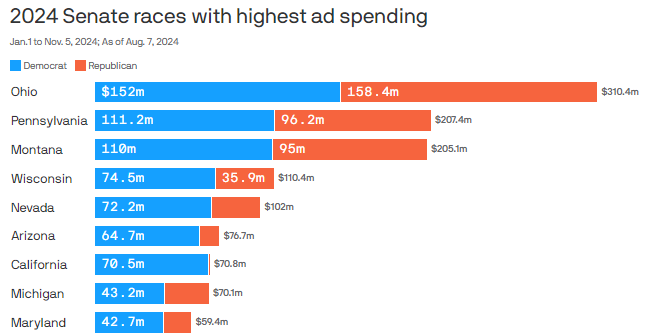 |
I know we’re all used to politics being out-of-hand expensive, but this is a astounding amount of money. In Montana, spending has ballooned since Axios wrote this article, and spending will exceed $250 per person in the state.⁶ In Nevada, spending in its Senate race will end up approaching $50 per person.⁷
There are diminishing returns in political advertising. These races are way past that point.
Missourians for Constitutional Freedom and WelcomePAC
Finally, two organizations worthy of support:
I’ve written about abortion access in Missouri. It’s important, and if it passes in a state as Republican as Missouri, it creates a roadmap to pass it in the rest of the country. A robust turnout on this issue will help other Democrats running in competitive state legislative races, like State Senate candidate Joe Pereles.
WelcomePAC focuses on the toughest winnable U.S. House races by supporting strong candidates and building a big tent. Whether their slate of candidates wins will be a difference-maker if the Democrats are to win back a majority in the House.
2. Text your friends and family
According to one study, the impact of texting your friends and encouraging them to vote is staggeringly high: friends you text and encourage to vote are 8.3% (!) more likely to do so.⁸
I’m all for creative get-out-the-vote strategies.⁹ But texting your friends regardless of where they live—but in particular, your friends who live in swing states—is simple, and it’s the highest-impact thing you can individually do.
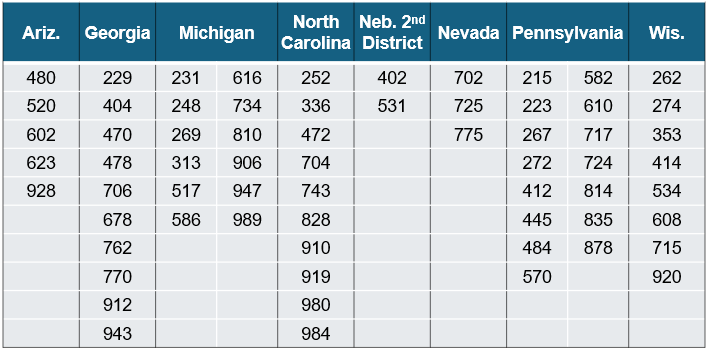
Not sure who you know in a swing state? Here’s a cheat sheet of every area code in every swing state. Take five minutes to search through your contacts; you can look people up by their area code, and you can see if you know anyone there:
 |
By the way, the benefits of reaching out to friends goes way beyond voting:
“Reaching out to friends…—particularly with those we haven’t spoken to in a while—can have a larger positive impact than we might think.” (Source)
“In a series of studies, including those involving students and adults, senders underestimated how much the communication meant to the recipient.” (Source)
By texting friends and encouraging them to vote, you aren’t only being a good citizen. You’re also being a good friend!
3. Vote!
Finally: you should vote early. In Missouri, early voting begins on October 22. You can also check your voter registration status and see your ballot on the Secretary of State website.
If you live elsewhere in the country, the National Association of Secretaries of State will help you check your voter registration.
You, your friends, and your family—and especially any young people you know—should make a point of voting early. Why?
People are less likely to vote when it rains.¹⁰ For every half-inch of rain, turnout declines by 1.2%. From the same study: “young voters are up to six times more susceptible to bad weather.” Six times! If there’s a half-inch of rain on election day, youth turnout could decrease by as much as 7.2%. Democrats need young voters to turn out if Harris is going to win; we should hope for election-day sun.¹¹
When it’s colder, people vote less. Specifically, every temperature increase of 2°F increases voter turnout by 0.16%.¹²
Obviously, voting early is a hedge against being sick on election day too. For all that people focus on messaging and turnout, it is remarkable how much these sorts of exogenous things matter.¹³
And if you’re in Missouri, remember to:
Vote NO on Amendment 2. Mobile sports gambling is dangerous, and Missourians should vote against it.
Vote YES on Amendment 3 and enshrine abortion access and reproductive healthcare in Missouri’s constitution.
Vote NO on Amendment 7, which does nothing to actually make our elections safer but does make common-sense democracy reform marginally harder.
The election is almost here
We’re in the home stretch of this election. If you’re feeling anxious about this—I am and most people I know are—do something about it!
Full disclosure: I think ActBlue is pretty terrible. They take a much larger fee than they should; they’re cavalier with how your data gets shared (which I’ve been both the victim of and, as a candidate and since, the beneficiary of); they don’t even work that well relative to other payment platforms. You should never make the voluntary donation to ActBlue that they solicit. But we’re close to an election, and it’s the fastest way to give.
When I give via ActBlue, I do so using a so-called “burner” email address and phone number—that keeps me from getting hit with endless spam in the future. Feel free to do the same. Here’s a service I use sometimes when I need a temporary, one-time email address; here’s one I’ve used for temporary, one-time phone numbers.
You are required to share some accurate personal information: your name, occupation, and address. But that’s it.
I’ve also set up the link in a way where a) you can customize how much you give each candidate, and b) the campaigns won’t get your email addresses, unless you opt in.
A fourth theoretically possible outcome—Harris wins and Republicans hold the House—is very unlikely.
Full disclosure: I do some work for WelcomePAC. But this email isn’t in coordination with them (and in fact, their candidates aren’t the same as the ones on my list); my encouraging you to support them is because I think they’re well positioned to help Democrats win some of the toughest House races in the country.
There are shades of the 2014 U.S. Senate race in Kansas in this race, hopefully with a different outcome.
Same thing is true with Cooke in Wisconsin and Shah in Arizona: if they can turn out lower-propensity voters, that’s good for Harris too.
In an election, unfortunately, that isn’t shaping up to be particularly close. It’s an outrageous sum of money for such a small state; with the amount they’re spending, they could literally buy groceries for every single household in the state for close to a month. (Based on an average household size of 2.4 people.)
In an election, fortunately, that isn’t shaping up to be particularly close.
Two caveats to this:
Some of this was measured during the COVID-19 pandemic, when perhaps digital communication had a larger impact.
I haven’t seen this study replicated elsewhere.
With all that said: even if the impact is a fraction of this 8.3% figure, it’s still hugely important.
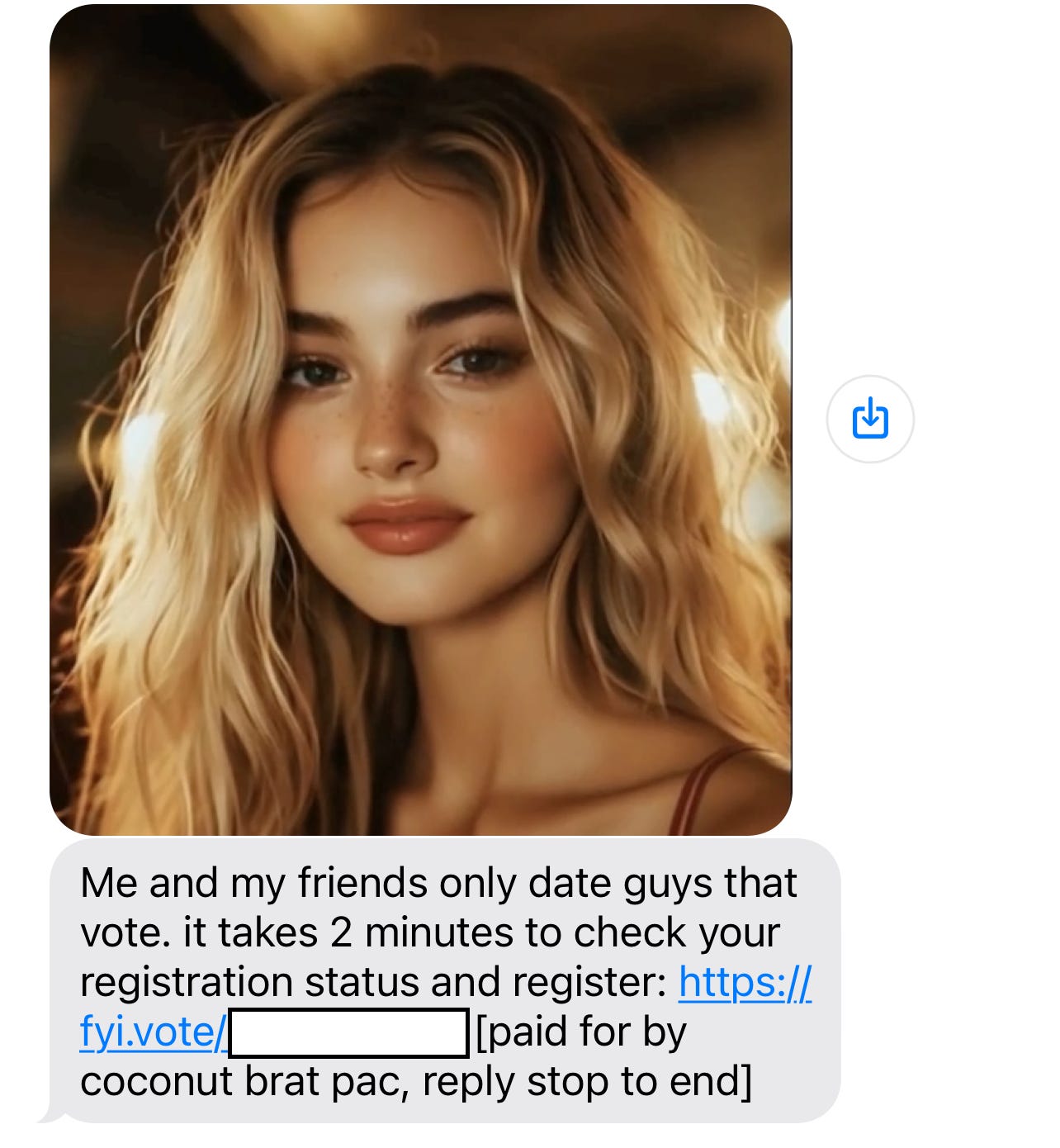
Take, for instance, this text I got on Friday (below). And yes, this is still less effective than texting your friends and family to get them to vote. (Coconut Brat PAC, by the way, does appear to be a real group.)
 |
“It should be sunny more” is not a formal policy position. Maybe it should be.
For context: Georgia was decided by 0.24% in 2020. Lauren Boebert won reelection in Colorado by 0.17% in 2022. So yes, those margins absolutely matter.
Case in point: if in Jacksonville, Florida on November 7, 2000 at noon it had been 80°—rather than 78°—Al Gore may very well have been President of the United States, at least according to one study.
| ||||