|  | Know better. Do better. |  | Climate. Change.News from the ground, in a warming world |
|
| | A "testing ground"Laguna de Bay, a massive lake neighbouring Manila, is one of the Philippines' biggest sources of fish.
But as demand for power surges in the capital and beyond, the government is eyeing up the freshwater lake for another use: solar power.
This week, Southeast Asia correspondent Mariejo Ramos reports on these plans for floating solar panels which local fishermen worry could sink their profits.
The Philippines wants to produce half of its electricity from renewable sources by 2040, compared with just a fifth in 2021. But as an archipelago of more than 7,000 islands, the country has limited land resources. And Laguna de Bay spans 91,000 hectares.
That makes floating photovoltaics - or solar panels installed on bodies of water - sound appealing. The proposed Laguna Lake project would become the world's largest on a natural lake, generating about 2 gigawatts of electricity for the Laguna area and Manila by 2026. 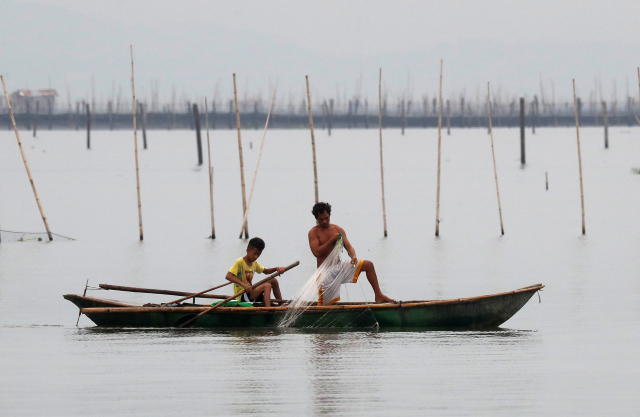 Fishermen recover nets at their fishpens in Laguna de Bay, in Muntinlupa, Metro Manila, in Philippines, September 14, 2018. REUTERS/Erik De
Castro |
Fishermen, however, are worried their work might dry up. Almost a third of all Filipino fishers live below the poverty line.
“Laguna Lake gives life and income to fishermen like us who didn’t finish school,” said Alejandro Alcones, a 55-year-old father of two who earns an average 5,000 Philippine pesos ($87) a month.
A January report by the Responsible Energy Initiative of Forum for the Future, an NGO group, described the project as a “testing ground” for the technology, and warned that such technologies threaten to compete with those dependent on fishing and agriculture.
So what will happen to Alcones and the 13,000 others who depend on the lake? |
Renewables vs fishingThe local authority involved in this battle, the Laguna Lake Development Authority (LLDA), said it regularly meets with fisher groups to hear their concerns and is doing all it can to not "dislocate" them.
But the Philippines’ largest fishermen’s alliance, the National Federation of Small Fisherfolk Organizations in the Philippines, or Pamalakaya, says the project could impact more than 8,000 fishermen and could shrink their fishing grounds.
They are also worried about the waterborne solar panels reducing catches, impeding boats, or even destroying docks if they become untethered during strong typhoons and rising water levels.
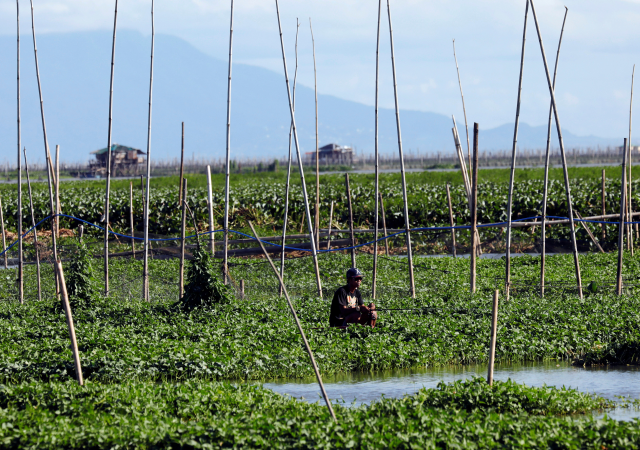 A man is fishing at Laguna Lake in Taguig, metro Manila, Philippines February 28, 2018. REUTERS/Dondi Tawatao |
On the other hand, people need energy. And as Southeast Asia's most coal-dependent country - responsible for about 62% of its electricity production last year -
the supply needs to become cleaner.
The Laguna Lake project would power 2 million homes, Mylene Capongcol, assistant secretary at the Department of Energy, said in a statement to Context.
And the slow adoption of clean energy is partly driven by competition for land with agriculture, as just 18% of the island nation’s total land is deemed arable. Nations like the Philippines may have no choice but to dip their toes in the water.
“With the Philippines’ ambitious renewable energy targets, floating solar systems present an innovative alternative and opportunity to scale renewable energy,” said Marvin Lagonera, Forum for the Future’s energy transition strategist in Southeast Asia, told Context.
"However, as floating solar scales, it also risks similar competition for limited resources."
See you next week,
Jack |
|
|
| | Climate change makes wildfires in the Pantanal - between Brazil, Bolivia and Paraguay - more likely and worse | On the International Day of the World’s Indigenous Peoples, the Green Climate Fund and IUCN leaders call for more frontline support | Heat-related deaths are rising amid climate change, but many countries struggle to collect the data | |
| |
| | | |
|