Feminist Majority Political Report |
HERE'S THE BEST FROM THE FEMINIST NEWS WIRE
|
|
|
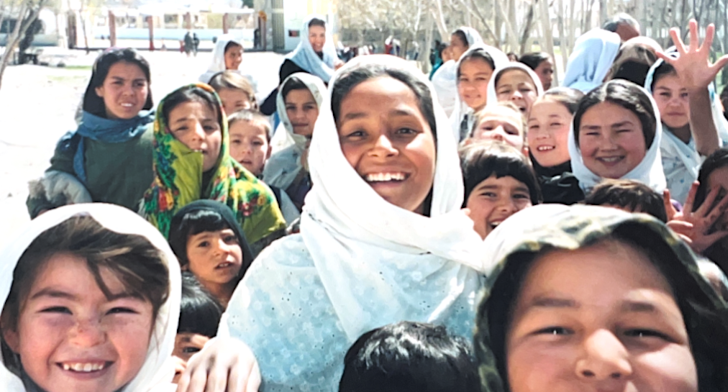
Afghan girls attending school in 2006 before the Taliban’s return to power. |
U.N. Report: Taliban’s Treatment of Women is Gender Apartheid |
On June 18, the United Nation’s Special Rapporteur on the human rights situation in Afghanistan, Richard Bennett, presented a mandated report to the U.N.’s High Commissioner for Human Rights. The report states that the “phenomenon of an institutionalized system of discrimination, segregation, disrespect for human dignity and exclusion of women and girls,” is Gender Apartheid. The report also brought to light the numerous human rights violations being committed against women and girls in Afghanistan by the Taliban. Over 100 edicts have been issued by the Taliban harshly restricting the rights of women and girls. These edicts ban girls from education beyond the 6th grade, from leaving their home without a male chaperone, and from accessing employment opportunities — excluding them from participating in all areas of public life.
In the report, Bennett makes it clear — the Taliban is currently engaging in Gender Apartheid. The term Gender Apartheid is defined by the report as “the institutionalized and systematized nature of the exclusion of and discrimination against women and girls…apartheid regimes enshrine and enforce a complex system of governance–of laws, policies, and practices–to systematically oppress and dominate a subset of society over the course of decades and generations.” The labeling of the human rights abuses against women as a Gender Apartheid by the U.N. Special Rapporteur demonstrate the severity of the treatment Afghan women face every day. It also aims to highlight the duty of states to intervene and take action in the protection of Afghan women — much like the international community did during the South African racial apartheid — rather than normalizing the rule of the Taliban.
CONTINUE READING |
|
|
Supreme Court Upholds Federal Law Protecting Survivors of Domestic Violence
|
On June 21, the Supreme Court ruled 8-1 in favor of a federal law prohibiting those with a domestic violence restraining order against them from possessing a firearm. The federal law in question under United States v. Rahimi (2024) was the 1996 Domestic Violence Offender Gun Ban, often referred to as “the Lautenberg Amendment,” after its sponsor, the late Sen. Frank Lautenberg (D-N.J.). While individuals convicted of felonies are banned from owning guns, this law also included those convicted of misdemeanor domestic violence.
The Feminist Majority, partnering with the National Network to End Domestic Violence and its then director, former Congresswoman Donna Edwards, played a pivotal role in passing this law to protect survivors of domestic violence. As a result of this Supreme Court ruling, the Domestic Violence Offender Gun Ban has survived yet another attempt to gut the law and put guns back into the hands of dangerous individuals.
In United States v. Rahimi, Justice Roberts argued that the Domestic Violence Offender Gun Ban fell in line with America’s regulatory tradition by temporarily disarming an individual who poses a credible threat to another. Multiple justices also argued in favor of the federal law, since the restriction only applied to specific individuals rather than the public as a whole.
CONTINUE READING |
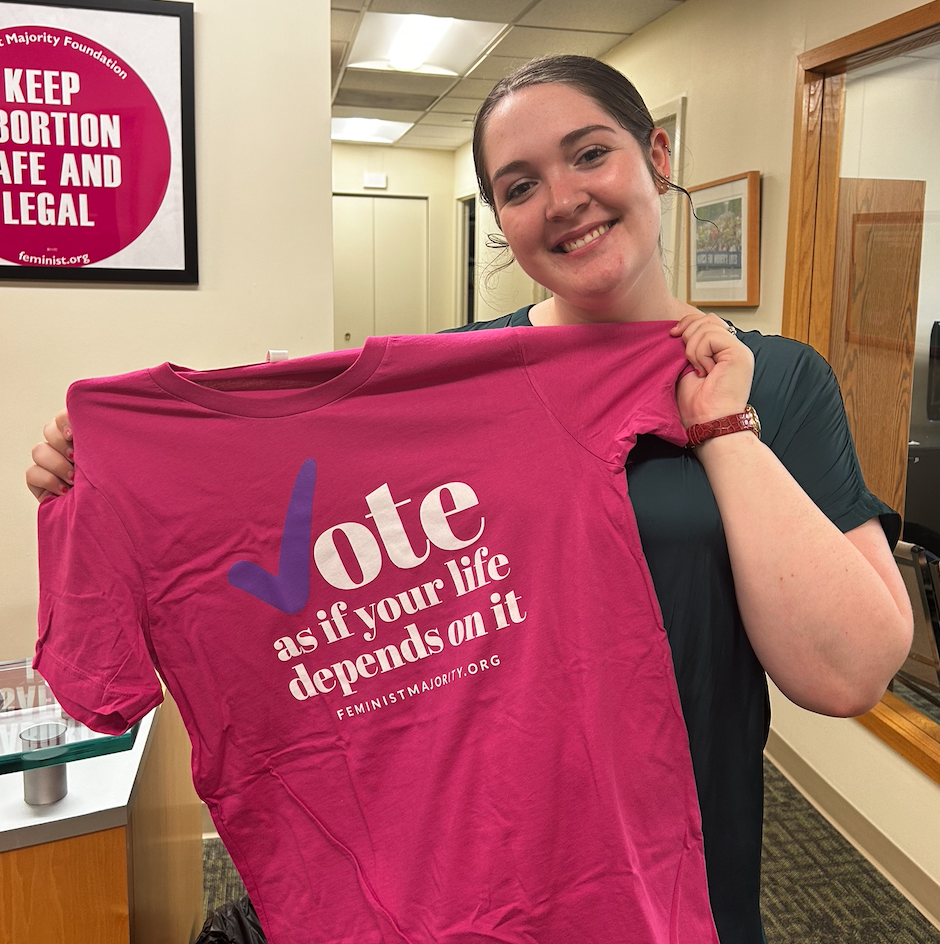
Student activist, Piper Duncan, is ready to encourage her peers to vote as if their life depends on it! |
|
|
Study Shows Record-Breaking Voter Turnout for Women in College |
For years, older generations have often viewed the youth vote as unimportant due to perceived low voter turnout and have stereotyped college students as politically unmotivated or even apathetic. While this may have been true in the past, a 2021 study conducted by Tufts University, entitled Democracy Counts 2020, has disproven this stereotype and shown how the youth vote may be a vital part of the upcoming 2024 Presidential Election.
Tufts University’s Institute for Democracy & Higher Education (IDHE) released its ground-breaking report, Democracy Counts 2020, a few months after the end of the 2020 Presidential Election. This report focused on the National Study of Learning, Voting, and Engagement (NSLVE), a combined database of university students and voting records dating back to the 2012 election. The NSLVE was created to help research the correlation between college education and political participation. The study’s early data about voter turnout in the 2012, 2014, and 2016 elections showed that student voter turnout was concerningly low. In more recent years, however, student voter turnout has increased drastically.
The Tufts study found that in 2016, 52% of college students in their database voted, compared to 61% of Americans. In 2020, however, the voter turnout for college students jumped to 66%, a shocking 14 percentage point jump from the 2016 election. This is especially important compared to the change in voter turnout among the general American public, which only increased by 6 points (67%). This unprecedented change in voter behavior among young people has closed the gap between generations, meaning that university students come within 1% of the national voting rate, shattering stereotypes about low voter turnout for young people.
CONTINUE READING |
|
|
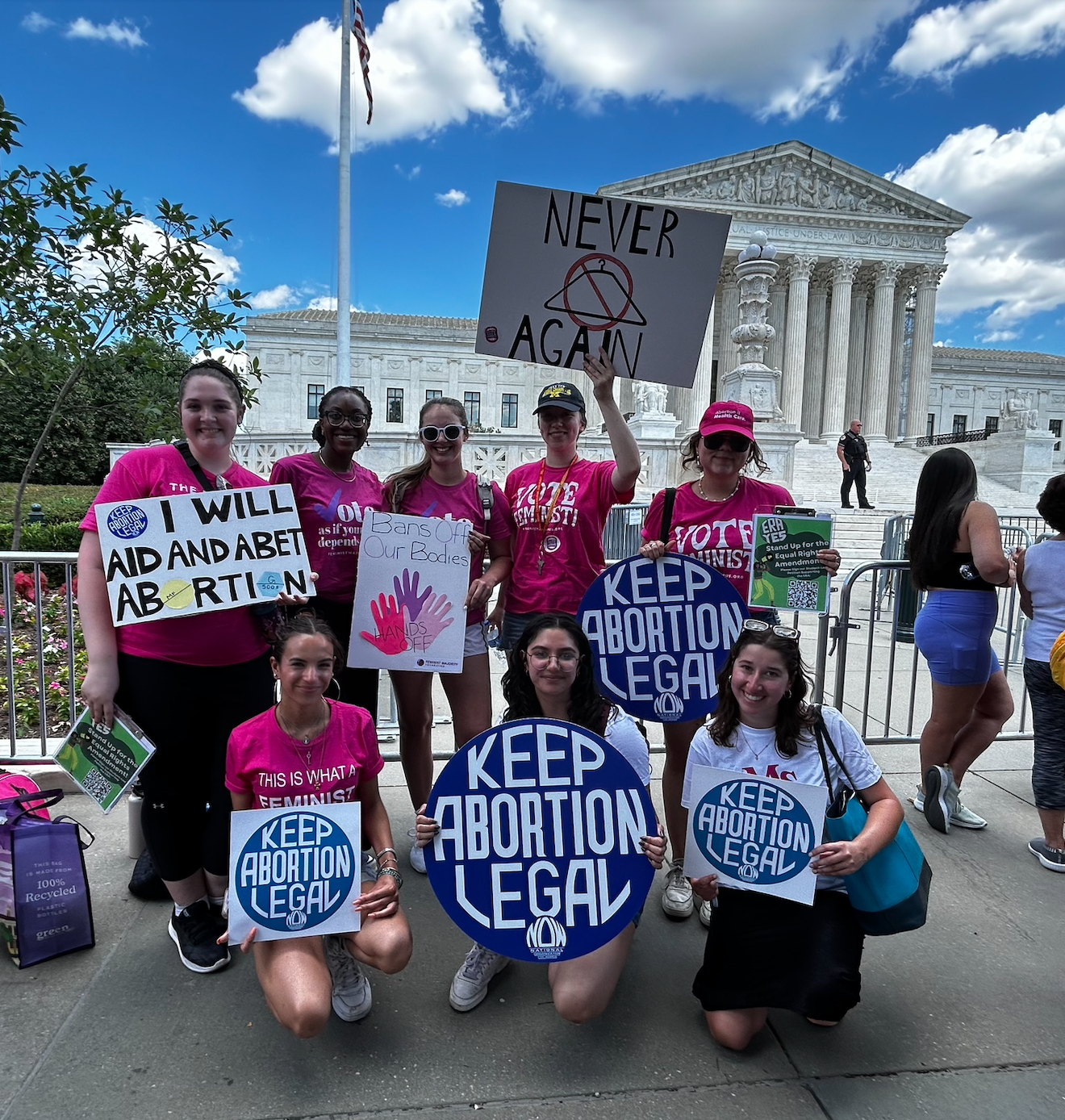
Student activists support abortion rights on the 2nd anniversary of Dobbs. |
|
|
The Ever-Widening “Gender Chasm” of the Upcoming 2024 Presidential Election |
The gender gap, coined by Feminist Majority Foundation founder and president, Eleanor Smeal, describes the percentage difference between women and men voting for a specific candidate and has existed since at least the 1980 presidential election. In that election, while a slim majority of women did vote for Ronald Reagan, they did so at a rate of 8 points less than their male counterparts. As Smeal wrote in The Feminization of Power, "the gender gap in voting and public opinion shows that a significantly larger percentage of women voters than men voters support women's rights, civil rights, legal abortion, and increasing public spending for social programs."
Since 1996, women have consistently favored Democratic candidates, including in 2016, when most women voted for Hillary Clinton. The 2016 election marked a spike in the gender gap, with an 11-point difference between women and men votes for Donald Trump. Since 2016, the gender gap has continued to widen into a chasm as Gen Z has begun voting and more issues continue to divide our country.
In 2020, according to the Roper Center of Cornell University, the gender gap continued to widen, with 57% of women voting for Biden, as opposed to 45% of men. This marked a new record for the gender gap in American politics of 12 points. This marked a new record for the gender gap in American politics of 12 points. However, landmark decisions regarding women’s rights, including the overturn of Roe v. Wade, as well as increasingly polarizing politics have rocked the country, making the gender gap an even more remarkable aspect of the upcoming 2024 election.
Recent polls have predicted this widening of the gender gap, including one conducted on May 22, 2024 by Quinnipiac University. The poll showed that the margins between Biden and Trump are small, yet the gender gap has increased since 2020. When asked who they would vote for if given the option between Trump and Biden, 58% of women said they would vote for Biden, and only 37% for Trump. For men, 37% said they would vote for Biden, and 57% said they would vote for Trump. This is a 21-point gender difference between Biden voters and a 20-point gender difference between Trump voters. With the election still months away, these polls may change, however, as of now there is a massive gender gap in voter preference for Biden and Trump.
|
|
|
Activist Profile: Hannah Irvine |
School: Cornell University
Major: Government with a minor in History Fun Fact: Hannah loves cooking, the theatre, and speaks fluent German! What moment in your activism has stood out for you?
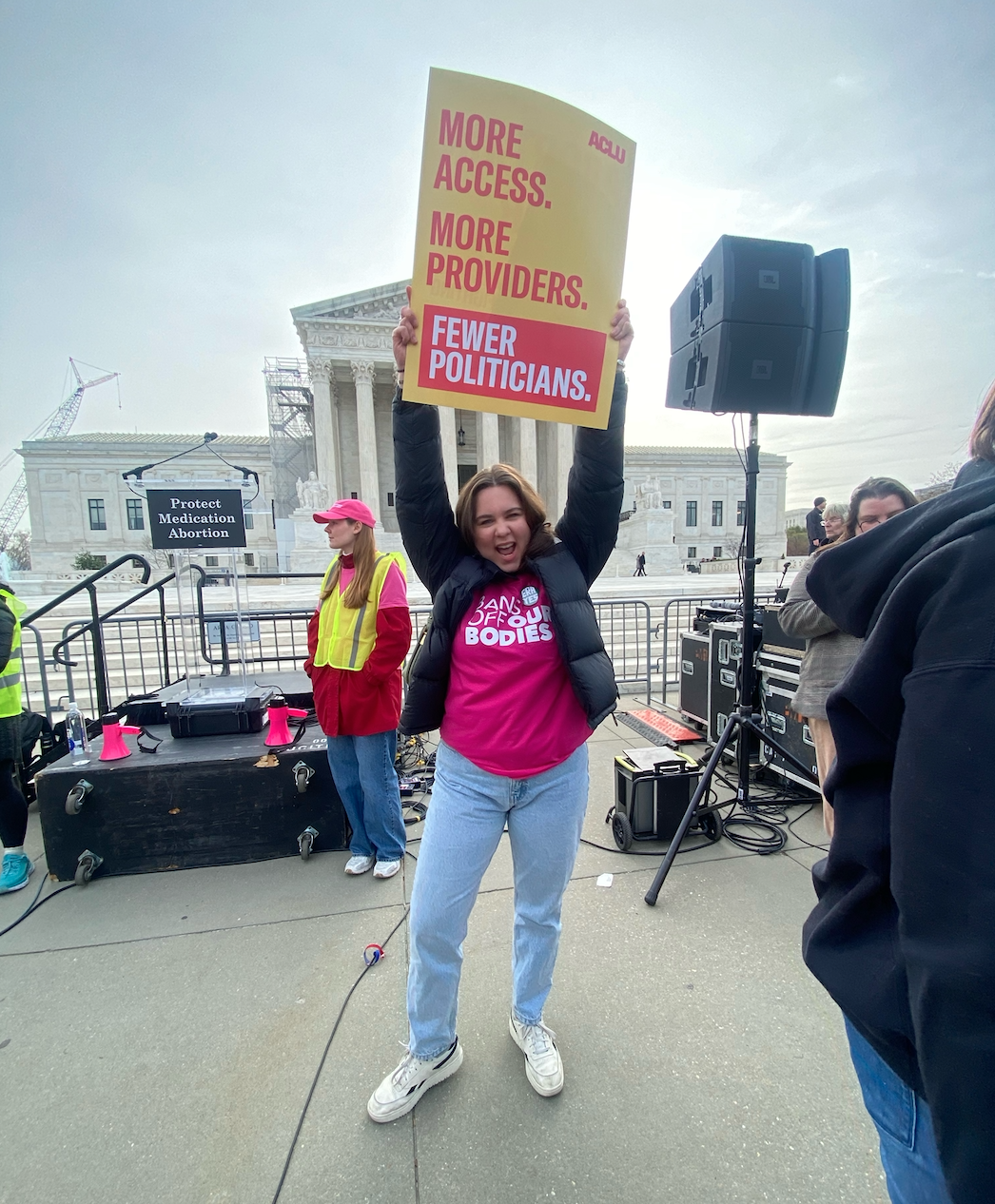
One of the most rewarding moments during my time working with FMF was attending the rally at the Supreme Court during the Mifepristone hearing. Being around like minded colleagues and activists made me so feel proud and confident about the cause that we have all been fighting for. The atmosphere was electric and there was a sense of solidarity among strangers that only happens when you fundamentally agree on something. |
|
|
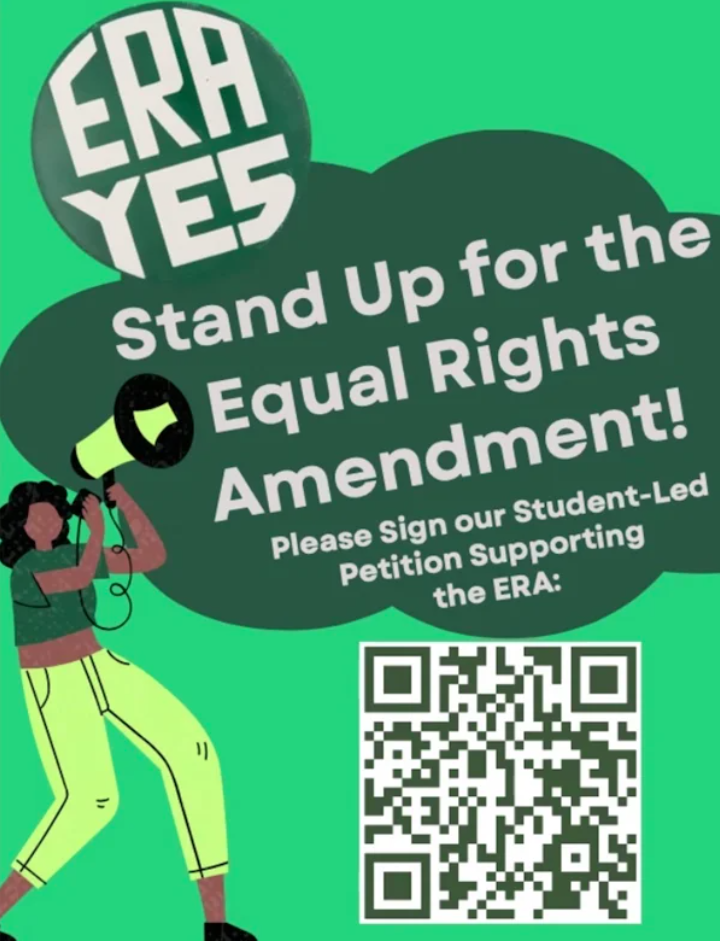
Show your support for the ERA! Go to sign4era.org or scan the QR code! |
|
|
HELP GET OUT THE VOTE IN NOVEMBER! |
Vote for Equality, an independent expenditure campaign of Feminist Majority, is recruiting community college and university students, as well as recent grads, to be Campus Organizers and Coordinators for our student voter mobilization campaign. Our goal is to deliver a massive student vote to stop the backward trend on fundamental rights. Vote for Equality will be conducting student-led campaigns in Arizona, California, Nevada, New York, North Carolina, Michigan, Ohio, Pennsylvania, and Wisconsin.
|
Campus Coordinators: 15-20 hrs/wk at $17-$20/hr depending on experience |
- recruit, hire and guide teams of campus organizers through Election Day;
-
work with allies to deliver a massive student vote;
- work with the administration to encourage student voting on campus;
- train Campus Organizers and volunteers on voting requirements and regulations in the state;
- and organize events to encourage voter turnout during Early Voting and on Election Day.
|
Campus Organizers: 5-15 hrs/wk at $16/hr |
-
work in teams on campus through Election Day;
- educate students about their right to register and vote where they attend school;
- speak to classes, dorms, student clubs and at campus events about what’s at stake in the election;
- recruit volunteers and organize leafleting drives, chalking parties, and other visibility activities;
- and organize GOTV events for Early Voting and through Election Day.
|
If you would like to work in CA, NV, AZ, or WI, applicants should submit a cover letter describing activism and experience in leadership, resume (including GPA), and two references (including one from a professor or faculty member) to [email protected]. If you would like to work in MI, OH, PA, NC, or NY, applicants should send the same materials to [email protected].
Paid for by Vote for Equality, the political arm of the Feminist Majority, www.feministmajority.org, and not authorized by any candidate or candidate’s committee. |
|
|
ENJOYED THIS NEWSLETTER? FORWARD TO A FRIEND!
WAS THIS EMAIL FORWARDED TO YOU BY A FRIEND? SUBSCRIBE HERE. |
Follow us on Instagram @femmajority |
|
|
Feminist Majority
1600 Wilson Blvd
Arlington, VA 22209
United States
|
|
|
If you believe you received this message in error or wish to no longer receive email from us, please unsubscribe. |
| |
|