|  | Know better. Do better. |  | Climate. Change.News from the ground, in a warming world |
|
| | | By Jack Graham | Climate change and nature correspondent, UK | | |
|  |
| Climate U-turnsIf you read coverage of Britain's general election, you might have a hard time knowing there's a climate crisis happening.
The last time the country went to the polls in 2019, one in six articles in the British media mentioned the term "climate", according to data shared with Context by audience strategy consultancy AKAS.
This year, it's half that number. And just 2% of articles have mentioned “climate change” compared to 10% last time.
My story this week tries to find out why leaders have avoided climate change in the campaign.
With election day fast approaching on Thursday, Britain's political parties hold a range of views on net zero, yet these differences haven't become major talking points compared to other challenges like health and immigration. 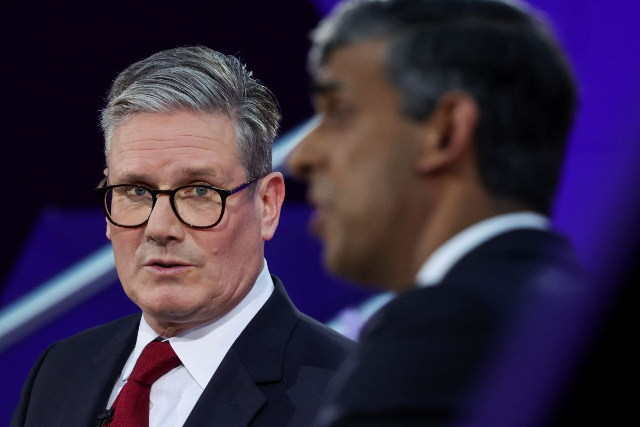 British opposition Labour Party leader Keir Starmer and British Prime Minister Rishi Sunak take part in BBC's Prime Ministerial Debate, in Nottingham, Britain, June
26, 2024. REUTERS/Phil Noble |
AKAS' Richard Addy told me there were a number of potential reasons.
The last election campaign took place during the COP25 climate meeting in Madrid and as Britain prepared to host COP26, for example. Then-Prime Minister Boris Johnson was also a vocal supporter of a political consensus behind climate action, Addy said.
A less charitable view would be that the largest parties, the Conservatives and Labour, have conducted major U-turns on green issues within the past year.
Conservative Prime Minister Rishi Sunak watered down key climate policies last year, referencing potential backlash to net zero, while Keir Starmer's Labour opposition scaled back its proposed green investment plans, blaming the economic downturn.
"Neither of the main parties, I think, wants to talk about it because they don't feel they have a particularly strong case," said Bob Ward, policy and communications director at the Grantham Research Institute on Climate Change and the Environment at the London School of Economics and Political Science. 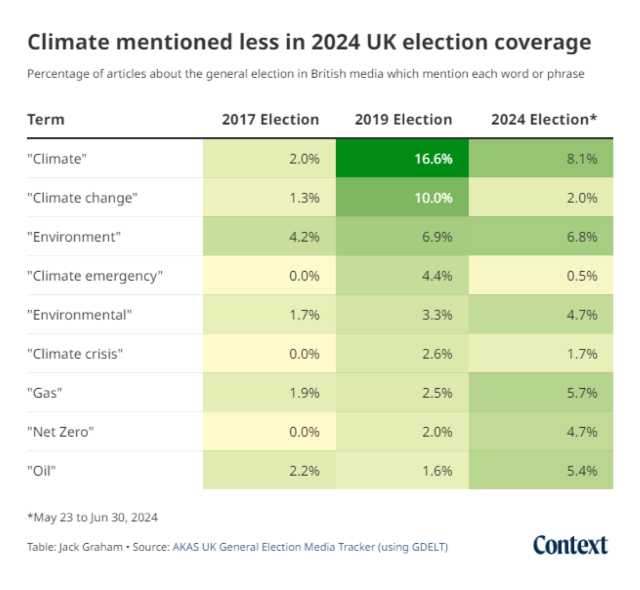 Thomson Reuters Foundation/Jack Graham |
Parties are splitAlthough the election campaign has heard little discussion on climate, digging into their plans reveals an increasing polarisation over net zero.
While the big parties both support the net zero target, Labour - expected to win a big majority - has been outspoken against the government's weakening of policies and has vowed to regain global climate leadership, which it says Sunak has surrendered.
Nigel Farage’s right-wing Reform UK wants to scrap net zero entirely, while the Liberal Democrats and Greens want the country to bring net zero forward to 2045 and 2040 respectively.
While these differing views haven't featured much during the campaign, a major concern for environmentalists is the lack of ambition and cash on the table.
Labour, expected to become the new government, this year scrapped a target to eventually spend 28 billion pounds ($35.5 billion) on green investments each year.
"We have got to have much stronger action on climate change from whoever is in government after the 4th of July," said Ward from the LSE.
"We're now at such a critical point it's just unthinkable that it won't be a major part of government."
See you next week,
Jack |
|
|
| | Historically opponents on many issues, environmental and labour groups are coming together across the country | United Nations Under-Secretary-General and AI expert Tshilidzi Marwala writes for Context ahead of the Bonn AI and Climate Expert Meeting | As Delhi grapples with record heat, one truck driver tells of delivering water to the capital's poor | |
| |
| | | |
|


