 | Know better. Do better. |  | Climate. Change.News from the ground, in a warming world |
|
| | | By Jack Graham | Climate change and nature correspondent, UK | | |
|  |
| Armed gangsThe Caribbean is bracing for hurricanes, from building flood defences to securing crucial food and hygiene supplies.
Up to seven major storms are forecast in what's expected to be an "extraordinary" Atlantic hurricane season.
But in Haiti, armed gangs are making any preparations far harder.
As Joseph Guyler Delva in Haiti’s capital Port-au-Prince and Anastasia Moloney in Bogotá report, this means the country is nowhere near ready.
Rampaging gangs have killed thousands of people and displaced many more in the capital while in coastal areas, like the town of Léogâne, hundreds of people are still living in tents after deadly floods last year.
With their lives upended by gang wars, Haitians are ill-prepared for more frequent and severe tropical cyclones driven by climate change.
|
Major ports are closed, cutting off key supplies of food, medicine and aid, intensifying a humanitarian crisis that has plunged about five million people into hunger. In the capital, food prices have soared because gangs have blocked transport routes and are charging people to get through.
"It is already a crisis," said Prospery Raymond, country director of a consortium of three NGOs in Port-au-Prince. "If a hurricane were to hit Haiti, it will have a catastrophic effect."
Across the region of Latin America and the Caribbean, 41 million people living in coastal areas are exposed to life-threatening storms and flooding, according to recent U.N. data. And many countries have hospitals in vulnerable coastal areas less than 10 metres above sea level. 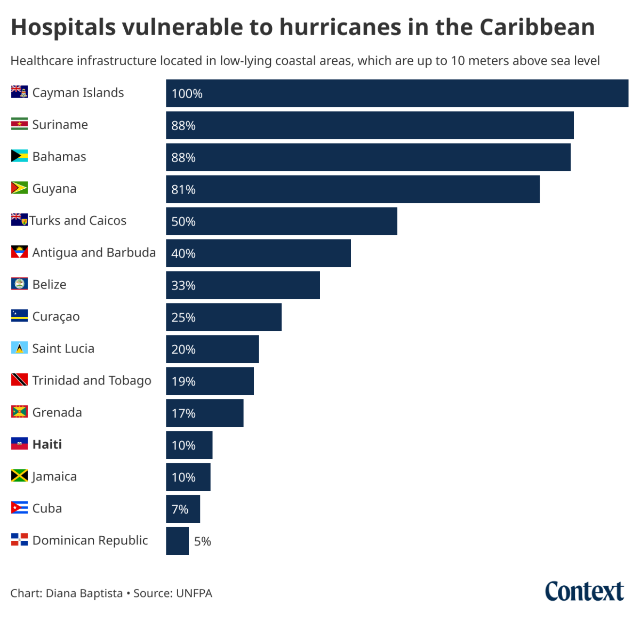 Diana Baptista/Thomson Reuters Foundation |
Running the gauntletDespite all these challenges,
work is underway to try to prepare.
A new disaster situation room was set up this month, volunteers have re-activated civil protection groups, and Haiti's National Emergency Operations Center (COUN) has restocked its central warehouse.
Distributing supplies like hygiene kits, tents and shovels is difficult, though, when gangs control entire neighbourhoods - setting up roadblocks and imposing curfews.
"We often have to skirt regular roads to avoid contact with armed bandits," said Emmanuel Pierre, who heads COUN. 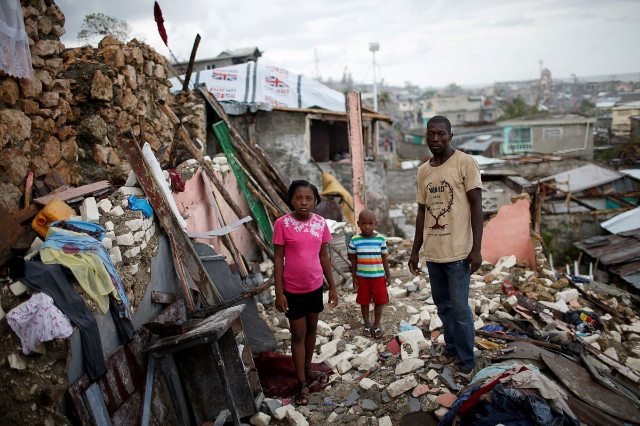 Prenille Nord, 42, poses for a photograph with his children Darline and Kervins among the debris of their destroyed house after Hurricane Matthew hit Jeremie, Haiti, October 17, 2016. REUTERS/Carlos Garcia Rawlins |
In response, COUN officials have been identifying local suppliers in
remote areas who can buy food and equipment, or have "cut a deal with some boat owners and captains" to buy supplies and ship them to communities, said Pierre.
For U.N. agencies and foreign aid groups trying to deliver vital items, political stability is a priority. Since a presidential assassination in 2021, gangs have expanded their control over Haiti and displaced thousands of civilians.
Interim Prime Minister Garry Conille was sworn in on June 3 and has named a new cabinet aiming to tackle the deep humanitarian crisis fuelled by the armed gangs.
Now, the race is on to improve the security situation and allow the nation to face up to a potentially even greater threat.
See you next week,
Jack |
|
|
|


