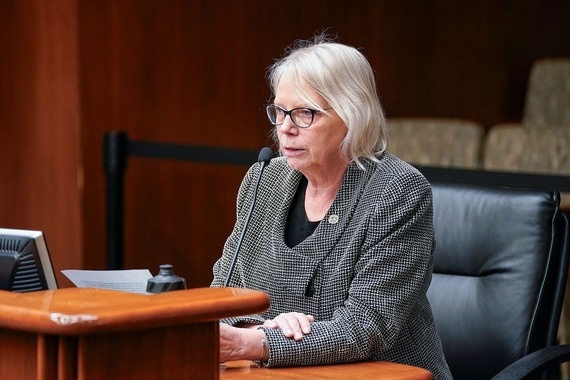
Legislation Addressing Straw Purchases of Firearms
This week, my fellow Burnsville Representative Kaela Berg presented legislation to the House Public Safety Committee that would make straw purchases of firearms a felony, strengthen the statutory definition of trigger activators, and require reporting on gun trafficking and firearm seizures. Our community is still reeling from the unthinkable and tragic shooting last month, and this legislation is an effort to prevent future tragedies like this from happening, and help stop gun violence in our communities altogether.?
Currently, straw purchases of firearms are a gross misdemeanor under state law. This legislation, incorporated under an amendment to HF 2609 the committee adopted, would update state law to more closely match federal law, under which straw purchasing firearms is already a felony.?
Additionally, the bill clarifies the definition of illegal ?trigger activators? under state law to prohibit so-called binary trigger devices that allow a semiautomatic gun to fire more than one shot with a single pull and release of a trigger. According to the federal indictment, one of the firearms used in the February Burnsville shooting was equipped with such a device. The legislation also requires the Minnesota Department of Public Safety to issue an annual report to the Legislature on firearms trafficking.?
DFLers are committed to taking action to prevent gun violence in our communities, and this legislation is an important step in keeping guns out of the hands of people who want to harm themselves or others.
Building a Clean Energy Future
In 2023, lawmakers answered the call from Minnesotans of all generations to take urgent action addressing our climate crisis by enacting a goal of 100% carbon-free electricity by 2040. To achieve this benchmark ? one of the most ambitious in the nation ? we need wind and solar farms to generate clean energy and transmission lines to carry that energy to the electric grid. There?s a big problem though: too many clean energy projects are stuck in a slow approval process. Today, about 51% of Minnesota?s electricity comes from carbon-free sources, but according to research, to reach our 100% goal, Minnesota must double the current pace at which new solar and wind energy sources are being developed.
That?s why I support the Minnesota Energy Infrastructure Permitting Act. This legislation ? which has earned broad support from Minnesota utilities, clean energy advocates, and our partners in labor ? will eliminate redundancies, increase transparency, and make Minnesota?s permitting process more efficient and consistent. Given Minnesota?s unpredictable weather, shaving even a couple of months off the permitting process could mean a difference of an entire year when it comes to construction. As addressing climate change becomes increasingly urgent, saving this time is more critical now than ever. Without upgrades to our decades-old energy permitting laws to meet the challenges we face today, our carbon-free ambitions may not become reality. The Minnesota Energy Infrastructure Permitting Act will help us meet this critical moment and remove barriers to the clean energy future all Minnesotans deserve.
Expanding Access to Affordable, High-Quality Health Care
|