| ? |
 |
|
Don't like ads? Go ad-free with TradeBriefs Premium    
CEO Picks - The best that international journalism has to offer!  S10S1 S10S1âÂÂItâÂÂs still very hard to just beâÂÂ: how workaholism can leave lifelong scars   When Marion's* workaholism caused her to lose the sight in one eye, her response was to work even harder to prove she was healthy and fit enough to do her job. When Laura lost consciousness during a meeting because she had worked 24 hours a day for the preceding three days, she was so appalled by the idea that people might think she was not able to work properly that she got back up off the floor and insisted the meeting continue."On the rare occasions I was physically present, I wasn't mentally there: I was always thinking about work. Anything else left me entirely cold," he said. "I even moved abroad at one point so I could work without having to waste working time, pretending I was going to spend time with my family."
Continued here
|
| ? |
|
S2S3
| ? |
|
S4
| ? |
|
|
| ? |
|
|
|
S5Drive-Away Dollsâs Geraldine Viswanathan wants to be your next romcom queen  Geraldine Viswanathan is a minute or two late for our interview – she completely lost her car. When the 28-year-old star of Cat Person and Ethan Coen’s new film Drive-Away Dolls does appear on our video call, she’s sat in the front seat, laughing, holding her phone camera at a sort of Dutch angle to her face. “I’m in LA so it’s very, you know… A car is a second home,” she says, with a kind of throwaway pithiness.It’s surely an apt enough vantage point as any from which to discuss Drive-Away Dolls, a riotous and pinball-paced road movie directed by half of the former sibling team behind Fargo and The Big Lebowski. In it, her character, Marian, is a bookish lesbian in the throes of a romantic dry spell. Pursued by bungling goons, she drives a rented Dodge Aries from Philadelphia to Tallahassee alongside her friend Jamie, a promiscuous free spirit (and fellow lesbian) played by Margaret Qualley. Today, at least, the car Viswanathan is sitting in is going nowhere fast.
Continued here
|
S6S7Can an A.I. Make Plans? - The New Yorker (No paywall)  Last summer, AdamYedidia, a user on a Web forum called LessWrong, published a post titled “Chess as a Case Study in Hidden Capabilities in ChatGPT.” He started by noting that the Internet is filled with funny videos of ChatGPT playing bad chess: in one popular clip, the A.I. confidently and illegally moves a pawn backward. But many of these videos were made using the original version of OpenAI’s chatbot, which was released to the public in late November, 2022, and was based on the GPT-3.5 large language model. Last March, OpenAI introduced an enhanced version of ChatGPT based on the more powerful GPT-4. As the post demonstrated, this new model, if prompted correctly, could play a surprisingly decent game of chess, achieving something like an Elo rating of 1000—better than roughly fifty per cent of ranked players. “ChatGPT has fully internalized the rules of chess,” he asserted. It was “not relying on memorization or other, shallower patterns.”This distinction matters. When large language models first vaulted into the public consciousness, scientists and journalists struggled to find metaphors to help explain their eerie facility with text. Many eventually settled on the idea that these models “mix and match” the incomprehensibly large quantities of text they digest during their training. When you ask ChatGPT to write a poem about the infinitude of prime numbers, you can assume that, during its training, it encountered many examples of both prime-number proofs and rhyming poetry, allowing it to combine information from the former with the patterns observed in the latter. (“I’ll start by noting Euclid’s proof, / Which shows that primes aren’t just aloof.”) Similarly, when you ask a large language model, or L.L.M., to summarize an earnings report, it will know where the main points in such documents can typically be found, and then will rearrange them to create a smooth recapitulation. In this view, these technologies play the role of redactor, helping us to make better use of our existing thoughts.
Continued here
|
S8We Are Free to Change the World: Hannah Arendt, the Power of Defiant Goodwill, and the Art of Beginning Afresh  “We speak of four fundamental forces,” a physicist recently said to me, “but I believe there are only two: good and evil” — a startling assertion coming from a scientist. Beneath it pulsates the sensitive recognition that it is precisely because free will is so uncomfortably at odds with everything we know about the nature of the universe that the experience of freedom — which is different from the fact of freedom — is fundamental to our humanity; it is precisely because we were forged by these impartial forces, these handmaidens of chance, that our choices — which always have a moral valence — give meaning to reality. Whether our cosmic helplessness paralyzes or mobilizes us depends largely on how we orient to freedom and what we make of agency. “The smallest act in the most limited circumstances,” Hannah Arendt wrote in The Human Condition, “bears the seed of… boundlessness, because one deed, and sometimes one word, suffices to change every constellation.”
Continued here
|
S9S11How to Spot the Next Technology Breakthrough  In 2019, few people talked about messenger ribonucleic acid, or what is commonly known as mRNA. But by the fall of 2020, this acronym was all over the news because it enabled quick production of vaccines to fight Covid-19. Similarly, in the summer of 2022, few people knew what Generative AI (GenAI) meant. Yet the launch of ChatGPT in November made everyone aware of this technology’s immense opportunities. What happened? Between the summer and fall of 2022, Gen AI passed an inflection point. High uncertainty about its performance gave way to increased confidence that the technology would affect businesses in a significant way. We illustrate this trade-off between uncertainty and confidence in a simple figure below.
Continued here
|
S12Analyzing the CEOâCMO relationship and its effect on growth  Robert Tas: Across the industry, there are lots of titles and changes in the definition of marketing. We’ve seen new roles such as the chief growth officer, chief digital officer, and chief customer officer. The traditional four Ps of marketing have been fragmented across multiple roles in the organization, which creates a challenge.Robert Tas: The standard Procter & Gamble definition is product, price, place, and promotion. The four Ps have been moved into different parts of the organization. Even though some of this is good, you still need that aggregator, that chief customer advocate across the organization, to make sure the four Ps are working together synergistically.
Continued here
|
S13The vacation town that livestream shopping built  Fan Zhiwei, a 57-year-old small business owner in Liaoning, China, spends at least two hours on short-video and livestreaming app Kuaishou every day. Guided by the app’s algorithm, he usually watches videos about cooking, current affairs, and life as a retiree. Early in 2023, the app served him a video from “Xiao Zhang,” who appeared to be a real estate livestreamer giving viewers virtual tours of properties in the tropical Chinese town of Xishuangbanna. The streamer steadily moved his camera through apartments, pausing to answer questions from viewers in his comment section about natural light or parking facilities.Fan was hooked. He had heard of Xishuangbanna as a niche tourist destination, often marketed as “Thailand within China.” He found himself watching more streams from Xishuangbanna, showing off not just homes there, but the beauty of the landscape surrounding the city. Fan peppered Zhang’s comments with questions for weeks before submitting his number in a contact portal inside Kuaishou for a personal consultation.
Continued here
|
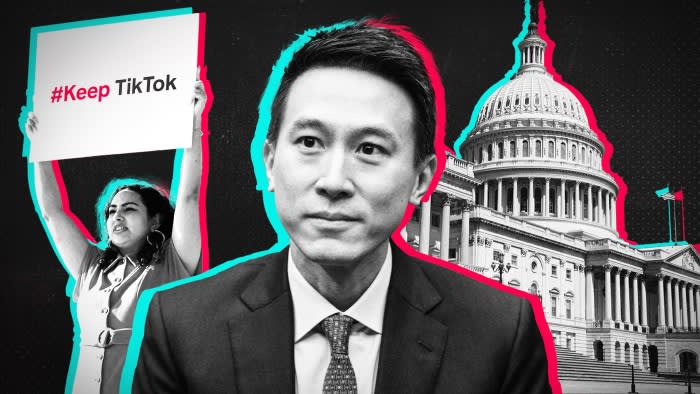
S14The Grim Reality of Banning TikTok  The U.S. government, once again, wants to ban TikTok. The app has become an introvertible force on American phones since it launched in 2016, defining the sounds and sights of pandemic-era culture. TikTok’s burst on the scene also represented a first for American consumers, and officials—a popular social media app that wasn’t started on Silicon Valley soil, but in China.On March 13, the U.S. House of Representatives passed a bill to force TikTok’s Chinese parent company, ByteDance, to sell TikTok or else the app will be banned on American phones. The government will fine the two major mobile app stores and any cloud hosting companies to ensure that Americans cannot access the app.
Continued here
|
S15How to verify a data breach | TechCrunch  Over the years, TechCrunch has extensively covered data breaches. In fact, some of our most-read stories have come from reporting on huge data breaches, such as revealing shoddy security practices at startups holding sensitive genetic information or disproving privacy claims by a popular messaging app.It’s not just our sensitive information that can spill online. Some data breaches can contain information that can have significant public interest or that is highly useful for researchers. Last year, a disgruntled hacker leaked the internal chat logs of the prolific Conti ransomware gang, exposing the operation’s innards, and a huge leak of a billion resident records siphoned from a Shanghai police database revealed some of China’s sprawling surveillance practices.
Continued here
|
S16How to Get Noticed by Your Bossâs Boss - Harvard Business Review (No paywall)  How do you get noticed by senior leadership without going over your boss’s head? One way to show how serious you are is to invest time outside of the office in learning skills that will help you grow and contribute to the company. This could mean taking courses that support the work you are doing, or reading texts in the areas you want to master. Senior leadership notices those who work collaboratively — so you should also be thoughtful in your interactions with others. Whether you are giving a presentation, working on a group project, or having a difficult conversation with your boss, it’s important to know your audience and prepare how you will communicate with them in advance. Finally, don’t be afraid to raise your hand and ask to participate in opportunities that could help you grow.
Continued here
|
S17These are the real dunes that inspired Duneâand you can visit them - History (No paywall) 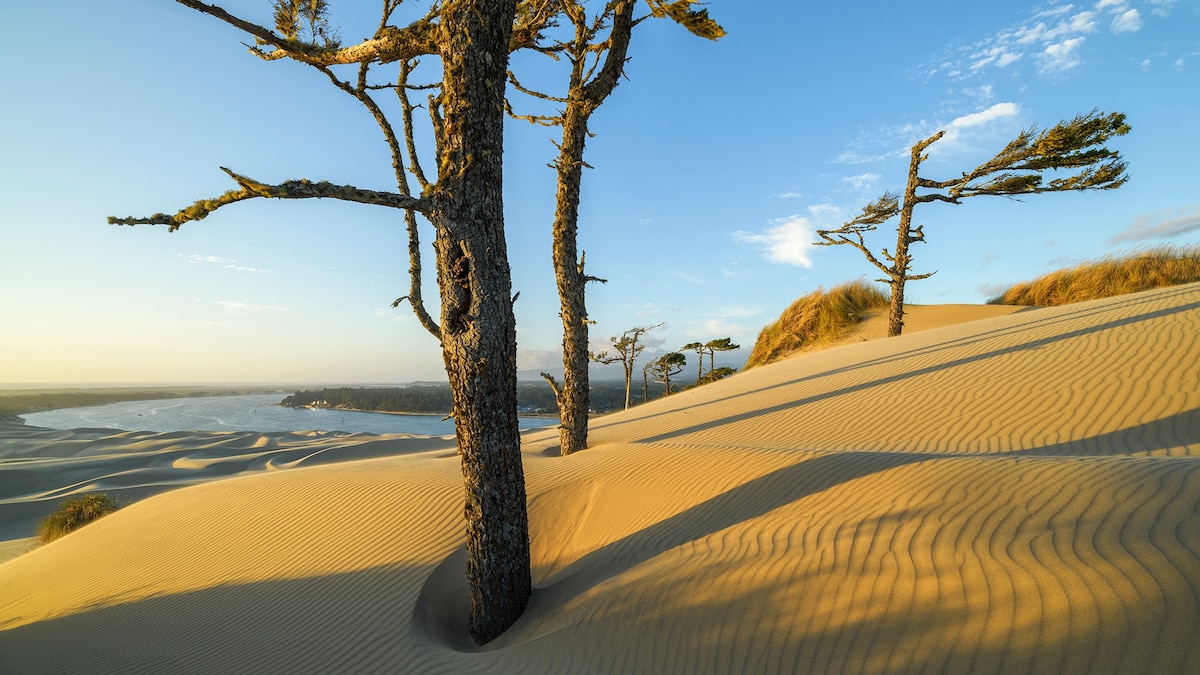 The iconic landscapes of Wadi Rum in Jordan and southern Africa’s Namib Desert have long been celebrated as the visual inspiration behind the fictional world of Arrakis in Frank Herbert’s 1965 sci-fi epic, Dune. However, the true origins of Herbert’s imagination lie closer to home, along the misty shores of the Oregon Coast.Stretching roughly 40 miles between the towns of Florence and North Bend, 7,000 acres of sand dunes run along the Pacific Coast. Protected as part of the 31,500-acre Oregon Dunes National Recreation Area, these 500-foot-high behemoths have been shaped over centuries by water and 100-mile-per-hour winds, resulting in North America’s largest expanse of temperate coastal dunes.
Continued here
|
S18Thereâs a better way to wake up. Hereâs what experts advise. - National Geographic Premium (No paywall)  Every morning, your brain needs to transition from sleep to waking. “It takes us a little while for our brains to come back online after we've woken up,” says Andrew McHill, director of the Sleep, Chronobiology, and Health Laboratory at Oregon Health and Science University. While your brain is booting up, you might get a hazy, confused feeling.Known as “sleep inertia” or “sleep drunkenness,” this feeling is perfectly normal and typically lasts for 20 to 30 minutes after we wake up, McHill explains. But if it lasts longer than that, it could be for various reasons, McHill says, including insufficient or poor sleep, the sleep phase you were in when you woke up, or even a sleep disorder.
Continued here
|
S19Ask Ethan: How did matter come to exist in our Universe?  Everywhere we look in the Universe, we find structure of some sort: planets, stars, gas, dust, plasma, and galaxies galore. Every indication we have is that each one of those structures we see is overwhelmingly composed of normal matter, like quarks and leptons, with only trace amounts of antimatter, made of things like antiquarks and antileptons. And yet, when we perform our particle experiments here on Earth, at low energies and at high energies, using particles from colliders as well as particles from cosmic rays, we always find the same thing: that our reactions, while they can create and destroy matter, can only do so at the expense of creating and destroying an equivalent amount of antimatter.So how, then, did all the matter, and not an equal amount of antimatter, come to exist in our Universe? That’s the topic of this week’s Ask Ethan question thanks to Mateen Khan, who writes in wanting to know:
Continued here
|
S20How to adapt the "theology of work" to Succession-era capitalism  In 1904, the German sociologist Max Weber wrote The Protestant Ethic and the Spirit of Capitalism. In the book, Weber argued that the paragon of “modern capitalism” was someone who “shuns ostentation and unnecessary show, spurns the conscious enjoyment of his power, and is embarrassed by the outward signs of the social esteem in which he is held… He gets nothing out of his wealth for his own person.”Weber died in 1920 and sadly never got to see Succession, The Real Housewives, or Bling Empire. He never popcorn-crunched his way through Leo’s The Wolf of Wall Street. I bet he didn’t even have a favorite Kardashian. If Weber were alive today, he’d be hard-pressed to see much that “shuns ostentation.” But we live in a different time, and the skyscrapers shadowing our cities are built on a very different ideological foundation.
Continued here
|
S21Are religions simply cults that have gone mainstream?  How would you feel if your next-door neighbor was in a cult? What if your son or daughter came home to inform you they had joined a “community of like-minded people”? In 2004, the theologian Paul Olson interviewed 2,400 randomly selected Nebraskans about how comfortable they would feel if their neighbor joined a cult or a new Christian church. More than 80% of respondents said they’d feel uncomfortable about living next door to a cultist, compared with only 6.1% disapproving of a new Christian church. It’s easy to imagine how they’d take the news coming from their child.
Continued here
|
S22Happiness poison--and the antidote  Let our sponsor BetterHelp connect you to a therapist who can support you – all from the comfort of your own home. Visit https://betterhelp.com/bigthink and enjoy a special discount on your first month.What is the one thing that, according to science, will make our lives richer and vastly more fulfilling? This 85-year continuing longitudinal study from Harvard says the answer is relationships.
Continued here
|
 |
TradeBriefs Publications are read by over 10,00,000 Industry Executives About Us | Advertise Privacy Policy Unsubscribe (one-click) You are receiving this mail because of your subscription with TradeBriefs.
Our mailing address is GF 25/39, West Patel Nagar, New Delhi 110008, India |