CEO Picks - The best that international journalism has to offer!
 S7S1 S7S1How Your Content Strategy Can Leverage AI Without Becoming 'Average Intelligence' - Forbes (No paywall)   In the rapidly evolving landscape of digital content creation, leveraging artificial intelligence has become a key factor in staying competitive. However, as AI becomes more ubiquitous, it's important for content creators to avoid producing mediocre, cookie-cutter content void of purpose. AI can't have its own opinions, so content produced solely using AI will be 'Average Intelligence,' just an amalgamation of everything already published online.No matter who (or what) is creating your content, you still need to make sure your content adds value and engages your audience. That's especially true when your content represents your brand. Here's how to make the most of AI in your content strategy while ensuring your brand stands out.
Continued here
|
S2How Do Chemicals in Plastics Impact Your Endocrine System? - Scientific American (No paywall)  The translucent exterior of a plastic soda bottle hides a secret in plain sight: hundreds of synthetic chemicals embedded in its seemingly innocuous material. These chemicals give the plastic its structure, flexibility and durability, among other qualities—the same traits that also make plastic last for centuries, causing it to accumulate and endure in nature.Before this plastic enters the natural ecosystem, the chemicals inside can leach out of water bottles and other food containers, entering the body and potentially endangering human health, according to a mounting body of research. In particular, plastic contains endocrine-disrupting chemicals (EDCs) that could wreak havoc on certain messaging systems in the human body.
Continued here
|
S3
S4Methane leaks in the US are worse than we thought - MIT Technology Review (No paywall)  The study, published today in Nature, represents one of the most comprehensive surveys yet of methane emissions from US oil- and gas-producing regions. Using measurements taken from planes, the researchers found that emissions from many of the targeted areas were significantly higher than government estimates had found. The undercounting highlights the urgent need for new and better ways of tracking the powerful greenhouse gas.Methane emissions are responsible for nearly a third of the total warming the planet has experienced so far. While there are natural sources of the greenhouse gas, including wetlands, human activities like agriculture and fossil-fuel production have dumped millions of metric tons of additional methane into the atmosphere. The concentration of methane has more than doubled over the past 200 years. But there are still large uncertainties about where, exactly, emissions are coming from.
Continued here
|
S5Muddy roads, angry farmers and civil war: one manâs epic run from Cape Town to London  The 12 ultramarathons that Deo Kato has completed in recent years look modest compared with his current challenge: running from Cape Town to London. The aim of his epic journey is no less ambitious: Kato wants to tell the story of human migration, highlighting parallels between the millions of people forced to leave their homes today in search of a better life and the earliest movement of humans from Africa.The 36-year-old Ugandan-born London-based runner started his journey on 24 July last year from Cape Town's Long March to Freedom monument, which commemorates the anti-apartheid struggle. He had hoped to complete the challenge in 381 days - the same number of days that African Americans in Alabama staged the Montgomery bus boycott of 1955 - but a number of setbacks has put him behind schedule.
Continued here
|
S6S8The Hidden Link Between Workaholism and Mental Health - The Atlantic (No paywall) 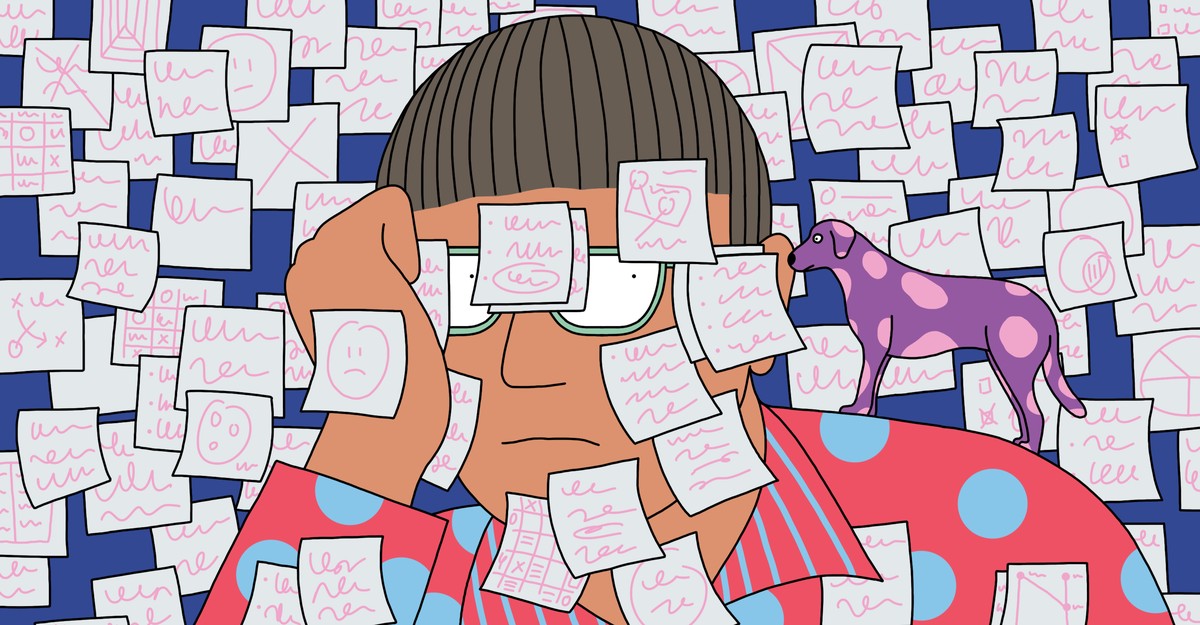 Winston Churchill was many things: statesman, soldier, writer. He was one of the first world leaders to sound the alarm about the Nazi menace in the 1930s, and then captivated the global imagination as a leader against the Axis powers in World War II. While prime minister of the United Kingdom during the war, he kept a crushing schedule, often spending 18 hours a day at work. On top of this, he wrote book after book in office. By the end of his life, he had finished 43, filling 72 volumes.Churchill also suffered from crippling depression, which he called his “black dog,” and which visited him again and again. It seems almost unthinkable that he could be so productive in states so grim that he once told his doctor, “I don’t like to stand by the side of a ship and look down into the water. A second’s action would end everything.”
Continued here
|
S9
S10
S11Why employee loyalty can be overrated - The Economist (No paywall)  Job interviews are an opportunity to see allegiances shift in real time. A candidate will usually refer to a prospective employer as “you” at the start of an interview (“What do you want to see from someone in this position?”). But occasionally the pronoun changes (“We should be thinking more about our approach to below-the-line marketing. Sorry, I mean ‘you’ should be”). That “we” is a tiny, time-travelling glimpse of someone imagining themselves as the employee of a new company, of a fresh identity being forged and of loyalties being transferred.Loyalty is seen as a virtue in most situations: among friends, family and football fans. Employee loyalty, however, is more complex. It is more transactional. Friends don’t give each other performance reviews or fire each other for cost reasons. It is less reciprocal. A worker can feel attachment to a company and a company can feel precisely nothing. (Which is why people often feel more loyal to team members and individual bosses than to their organisations.) And too much of it can impose high costs.
Continued here
|
S12The 4th Bitcoin Halving Explained 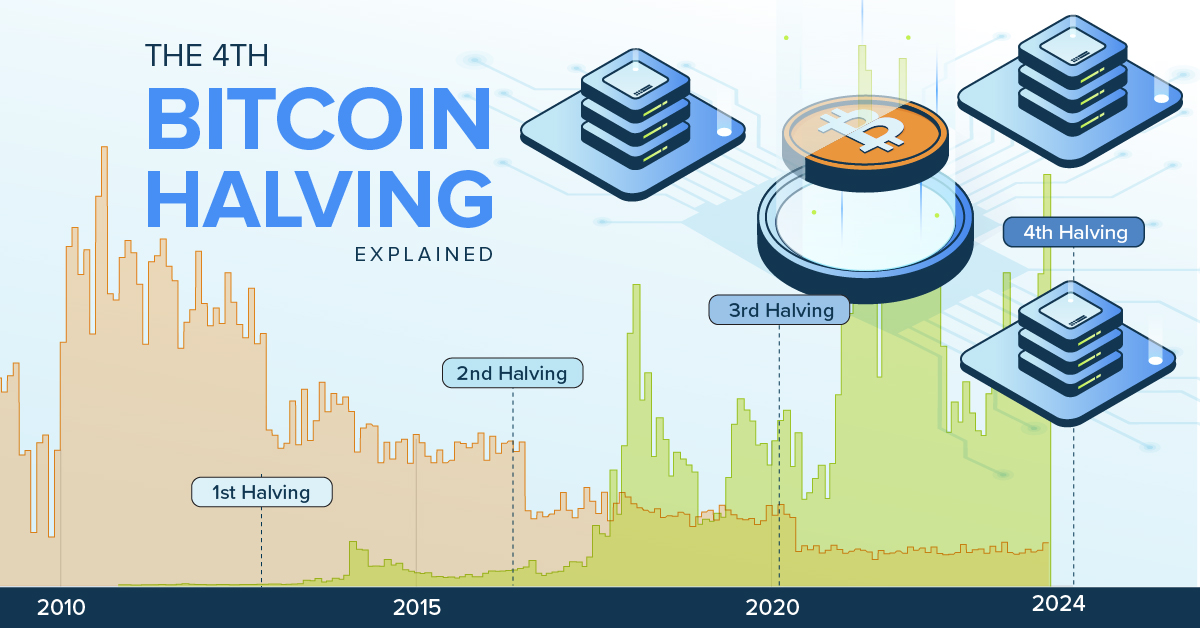 And if you look at historical miner revenue in bitcoin, you can see quite clearly, the steep drop in revenue after each halving. But what’s interesting, is that if you compare that against the miner revenue in USD, there is a drop there as well, but it recovers soon thereafter as the cryptocurrency appreciates. In other words, a miner may receive less bitcoin, but that bitcoin is worth more.If we look at the percent change in market capitalization post-halvings, we can see a bit of a pattern. After both the second and third halvings, market capitalization peaked at around the year-and-half mark. The second-halving peak occurred on day 526 at around $328 billion, an increase of 3,000%, while the third-halving peak came three weeks later on day 547 at over $1.2 trillion, or an increase of just under 700%.
Continued here
|
S13Some Candid Career Advice - The New Yorker (No paywall)  Lead with passion. Whatever kind of work you end up doing, find ways to incorporate it into a greater mission. Do you use exploitative offshore manufacturing practices to produce fast-fashion scarves? Recontextualize that as some kind of social good. That way, your company isn’t “operating sweatshops in a developing country”; it’s “giving back to global communities in need by empowering women of all ages.”Be true to yourself. But only once you’re well into your forties or fifties. Until then, accumulate wealth working in a morally ambiguous industry. Don’t pick an obvious baddie like Big Tobacco. You need plausible deniability with a long shelf life. Plenty of room for self-deception is key. If you surround yourself with enough people doing the same thing, it won’t feel ethically perverted. It will feel normal—inevitable, even. Distributed blame, banality of evil—how could all of these people be wrong? Look at Geoff. Geoff’s a good guy. He brought in Krispy Kreme for the team. You could work for a tech company as chief exploiting-children’s-immature-prefrontal-cortices officer, and just tell yourself that your role is all about “inspiring community.” Then, once you’ve hit middle age, when your stock options have vested and you own a house with a basketball court, you can manufacture a big ol’ epiphany. You can say, “Oh, wow, this is horrible,” and then spend the back half of your life railing against the industry that made you wealthy. Everyone loves a redemption story. They’ll celebrate you as a whistle-blower—a moral beacon. Remember, there’s no financial upside to being a good person from an early age. Cognitive dissonance is a tool. Use it to shut off parts of your psyche and activate others. When you watch “Succession” or “The Wolf of Wall Street,” you should be thinking, These are cool people. I want to live like this. This is how I would like to treat myself and others. Fundamentally misunderstanding movies and television is just part of being successful. We’re only a few hundred years out from our barbarous roots. This isn’t a rat race, it’s a death match. Hand washing Ziploc bags won’t solve climate change. No one else cares—why should you?
Continued here
|
S14The surprising ways animals react to a total solar eclipse - New Scientist (No paywall)  Adam Hartstone-Rose at North Carolina State University and his colleagues performed one of the biggest such studies during the eclipse that crossed the US in 2017. “To be entirely honest, I didn’t think we were going to see anything interesting. Animals see clouds go overhead all of the time, occasionally it’s overcast – I didn’t think animals were going to care at all about this,” says Hartstone-Rose. “Astonishingly, three-quarters of the species that we watched had some sort of reaction.”Most of those animals seemed to think it was nighttime during totality, the period in which the sun was completely hidden behind the moon. This might not come as a surprise to those who have witnessed a solar eclipse anywhere outdoors, as it has been known for centuries that birds and insects tend to quiet down and seek their nests.
Continued here
|
S15S16Alzheimer's may be caused by a build-up of fat in brain cells - New Scientist (No paywall)  But this debate ignores the fact that fat droplets can also be seen in the brains of people who have died from the disease, says Haney. These were first described by Alois Alzheimer, a German doctor who gave his name to the condition in the early 20th century, when he noted amyloid plaques, tau tangles and fat droplets present in the brains of people who had Alzheimer’s. But for decades the fat was mostly overlooked.To shed more light, Haney and his colleagues carried out a series of experiments while he was working at Stanford University in California. First, the team used a relatively recent technique called single-cell RNA sequencing to identify which proteins were being made in individual cells. They applied this to tissue samples from people who had died from Alzheimer’s disease, who had either two copies of the APOE4 variant or two copies of APOE3.
Continued here
|
S17How to Spot the Next Technology Breakthrough  In 2019, few people talked about messenger ribonucleic acid, or what is commonly known as mRNA. But by the fall of 2020, this acronym was all over the news because it enabled quick production of vaccines to fight Covid-19. Similarly, in the summer of 2022, few people knew what Generative AI (GenAI) meant. Yet the launch of ChatGPT in November made everyone aware of this technology’s immense opportunities. What happened? Between the summer and fall of 2022, Gen AI passed an inflection point. High uncertainty about its performance gave way to increased confidence that the technology would affect businesses in a significant way. We illustrate this trade-off between uncertainty and confidence in a simple figure below.
Continued here
|
S18Generative AI fuels creative physical product design but is no magic wand  QuantumBlack, McKinsey’s AI arm, helps companies transform using the power of technology, technical expertise, and industry experts. With thousands of practitioners at QuantumBlack (data engineers, data scientists, product managers, designers, and software engineers) and McKinsey (industry and domain experts), we are working to solve the world’s most important AI challenges. QuantumBlack Labs is our center of technology development and client innovation, which has been driving cutting-edge advancements and developments in AI through locations across the globe.Additionally, with the ability to visualize concepts in high fidelity much earlier in the design process, companies can elicit more precise feedback from consumers as they work to fine-tune every element of the user experience (see images below). In product research and design alone, McKinsey estimates gen AI could unlock $60 billion in productivity.1“The economic potential of generative AI: The next productivity frontier,” McKinsey, June 14, 2023.
Continued here
|
S19Greta Gerwigâs Next Big Swing  The filmmaker Greta Gerwig was in west London the other day when she walked past a movie set—not her own, but something that just happened to be filming on the street—and stopped for a moment to watch. A light was positioned in front of the house; a car pulled up and an actor got out, shaking the gates and yelling. There was an intensity to the scene, and a vulnerability to his performance. Then, abruptly, the spell was broken. Someone yelled: “Cut! Going again.” A groomer ran out to fix the actor’s hair, a mundane but crucial bit of business.“Movies!” Gerwig says, almost in the manner of an old-timey studio executive, recalling the moment. “Love ’em!” We’re having lunch in Soho; she’s in London while her husband, the writer-director Noah Baumbach, preps production on his next film, and while she works on a new adaptation of the first book in C.S. Lewis’ Chronicles of Narnia series. It’s one of the biggest pieces of intellectual property of all time, but that’s a fitting thing to tackle after what’s been, for Gerwig, a remarkable year. Her dazzling, subversive Barbie, which she co-wrote and directed, grossed more than $1.4 billion at the box office, making it the biggest movie of the year, and the highest-grossing film ever directed by a woman. Barbie has since become a pop-culture phenomenon, from I Am Kenough hoodies to discourse over a third-act monologue delivered by America Ferrera about the impossible pressures women face. Alongside Christopher Nolan’s Oppenheimer, Barbie was credited with keeping the theatrical model afloat last year; in January, the film received eight Oscar nominations, including Best Picture as well as Best Supporting Actress for Ferrera.
Continued here
|
S20The Stages of Grief Are Unique to Everyone, but They Can Help us Cope  Although the process of grief is unique for each of us, it is indeed a process with certain similarities, something that psychiatrist Elisabeth Kübler-Ross understood. In the 1960s, her professional experiences with terminally ill patients not only led her to be a champion of hospice and palliative care — a woefully understudied and undervalued branch of medicine at the time — but also resulted in her writing the landmark 1969 book On Death and Dying. It’s in this book that Kübler-Ross first articulated what would become known as the five stages of grief. Over time, these stages would come to be applied not just to the terminally ill (and their families) faced with the imminent reality of death, but to anyone coping with loss in their lives, whether they were bereaving the death of a pet, the breakup of a relationship, the termination of a job, or some other form of loss. These stages would also be expanded in a variety of ways over time.
Continued here
|
S21These New Cancer Drugs Improve Outcomes for People with Hard-to-Treat Tumors - Scientific American (No paywall)  In the long and often dispiriting quest to cure cancer, the 1998 approval of the drug Herceptin was a tremendously hopeful moment. This drug for breast cancer was the first to use a tumor-specific protein as a homing beacon to find and kill cancer cells. And it worked. Herceptin has benefited nearly three million people since that time, dramatically increasing the 10-year survival rate—and the cancer-free rate—for what was once one of the worst medical diagnoses. “Honestly, it was sort of earth-shattering,” says oncologist Sara M. Tolaney of the Dana-Farber Cancer Institute in Boston.But the drug has a major limitation. Herceptin's beacon is a protein called HER2, and it works best for people whose tumors are spurred to grow by the HER2 signal—yet that's only about one fifth of breast cancer patients. For the other 80 percent of the approximately 250,000 people diagnosed with the disease every year in the U.S., Herceptin offers no benefits.
Continued here
|
S22How Blatantly False Headlines Can Distort What We Believe In - Scientific American (No paywall)  Politicians have never been known for a strict adherence to truth. U.S. voters admit they know their representatives routinely lie to them: voters routinely assume that even their own party’s politicians are dishonest about two fifths of the time, according to a 2021 study.But in this election year, a larger-than-life candidate is openly distorting reality and challenging fact on an unprecedented scale. Mendacity in the style of former president Donald Trump—and the uncritical repetition of such blatant lies—can measurably chip away at our ability to assess the plausibility of other, unrelated news stories, according to a new preprint analysis currently awaiting peer review.Repeatedly viewing obviously outlandish claims makes people more likely to believe more ambiguous-seeming ones, the behavioral and cognitive scientists behind the new study conclude. The team’s results deal primarily with people’s beliefs rather than their ability to detect fake news (after all, something can be hard to believe yet still true). But the researchers also looked at how increases in perceptions of believability influenced people’s overall view of the truth.
Continued here
|
S23S24Nintendo Switch Just Quietly Released the Most Immersive Star Wars Video Game of All Time  20 years (and a couple of forgettable reboots) later, it’s finally time to gear up for battle again.The orange Geonosis desert makes for a motivating training ground. Even as a Clone Trooper, clutching my Blaster Rifle and armored like a bug, I feel constantly exposed on the planet’s dry, open plains. Then again, this is Star Wars, and one soldier’s life (cloned or otherwise) barely matters against the scale of a massive intergalactic conflict. So I charge forward towards almost certain demise, and hopefully, victory.
Continued here
|
 |
TradeBriefs Publications are read by over 10,00,000 Industry Executives About Us | Advertise Privacy Policy Unsubscribe (one-click) You are receiving this mail because of your subscription with TradeBriefs.
Our mailing address is GF 25/39, West Patel Nagar, New Delhi 110008, India |