
Email
Economy Remix: What Can Be Done to Restrain Billionaire Wealth?
| From | Steve Dubb <[email protected]> |
| Subject | Economy Remix: What Can Be Done to Restrain Billionaire Wealth? |
| Date | March 13, 2024 5:59 PM |
Links have been removed from this email. Learn more in the FAQ.
Links have been removed from this email. Learn more in the FAQ.
As billionaires’ numbers rise, their political power grows. This trend must be halted.
View this email in your browser ([link removed])
** Economy Remix: What Can Be Done to Restrain Billionaire Wealth?
------------------------------------------------------------
[link removed]
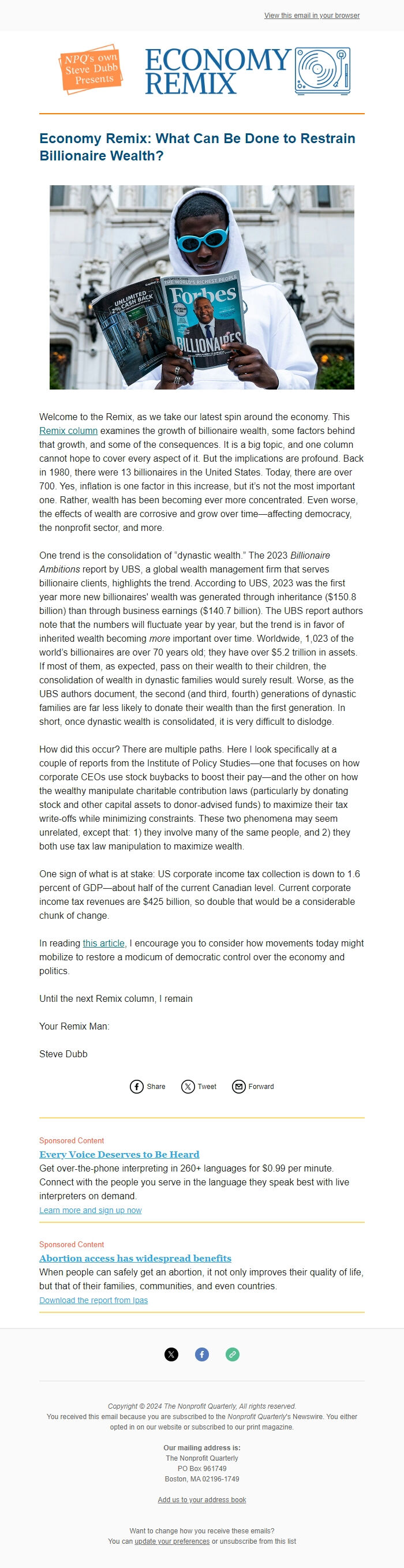
Welcome to the Remix, as we take our latest spin around the economy. This Remix column ([link removed]) examines the growth of billionaire wealth, some factors behind that growth, and some of the consequences. It is a big topic, and one column cannot hope to cover every aspect of it. But the implications are profound. Back in 1980, there were 13 billionaires in the United States. Today, there are over 700. Yes, inflation is one factor in this increase, but it’s not the most important one. Rather, wealth has been becoming ever more concentrated. Even worse, the effects of wealth are corrosive and grow over time—affecting democracy, the nonprofit sector, and more.
One trend is the consolidation of “dynastic wealth.” The 2023 Billionaire Ambitions report by UBS, a global wealth management firm that serves billionaire clients, highlights the trend. According to UBS, 2023 was the first year more new billionaires' wealth was generated through inheritance ($150.8 billion) than through business earnings ($140.7 billion). The UBS report authors note that the numbers will fluctuate year by year, but the trend is in favor of inherited wealth becoming more important over time. Worldwide, 1,023 of the world’s billionaires are over 70 years old; they have over $5.2 trillion in assets. If most of them, as expected, pass on their wealth to their children, the consolidation of wealth in dynastic families would surely result. Worse, as the UBS authors document, the second (and third, fourth) generations of dynastic families are far less likely to donate their wealth than the first generation. In short, once dynastic wealth is consolidated, it is very difficult to
dislodge.
How did this occur? There are multiple paths. Here I look specifically at a couple of reports from the Institute of Policy Studies—one that focuses on how corporate CEOs use stock buybacks to boost their pay—and the other on how the wealthy manipulate charitable contribution laws (particularly by donating stock and other capital assets to donor-advised funds) to maximize their tax write-offs while minimizing constraints. These two phenomena may seem unrelated, except that: 1) they involve many of the same people, and 2) they both use tax law manipulation to maximize wealth.
One sign of what is at stake: US corporate income tax collection is down to 1.6 percent of GDP—about half of the current Canadian level. Current corporate income tax revenues are $425 billion, so double that would be a considerable chunk of change.
In reading this article ([link removed]) , I encourage you to consider how movements today might mobilize to restore a modicum of democratic control over the economy and politics.
Until the next Remix column, I remain
Your Remix Man:
Steve Dubb
[link removed] Share ([link removed])
[link removed] https%3A%2F%2Fmailchi.mp%2Fnpqmag%2Feconomy-remix-62049 Tweet ([link removed] https%3A%2F%2Fmailchi.mp%2Fnpqmag%2Feconomy-remix-62049)
[link removed] Forward ([link removed])
Sponsored Content
Every Voice Deserves to Be Heard ([link removed])
Get over-the-phone interpreting in 260+ languages for $0.99 per minute. Connect with the people you serve in the language they speak best with live interpreters on demand.
Learn more and sign up now ([link removed])
------------------------------------------------------------
Sponsored Content
Abortion access has widespread benefits ([link removed])
When people can safely get an abortion, it not only improves their quality of life, but that of their families, communities, and even countries.
Download the report from Ipas ([link removed])
------------------------------------------------------------
============================================================
** ([link removed])
** ([link removed])
** ([link removed])
Copyright © 2024 The Nonprofit Quarterly, All rights reserved.
You received this email because you are subscribed to the <i>Nonprofit Quarterly</i>'s Newswire. You either opted in on our website or subscribed to our print magazine.
Our mailing address is:
The Nonprofit Quarterly
PO Box 961749
Boston, MA 02196-1749
USA
Want to change how you receive these emails?
You can ** update your preferences ([link removed])
or ** unsubscribe from this list ([link removed])
View this email in your browser ([link removed])
** Economy Remix: What Can Be Done to Restrain Billionaire Wealth?
------------------------------------------------------------
[link removed]
Welcome to the Remix, as we take our latest spin around the economy. This Remix column ([link removed]) examines the growth of billionaire wealth, some factors behind that growth, and some of the consequences. It is a big topic, and one column cannot hope to cover every aspect of it. But the implications are profound. Back in 1980, there were 13 billionaires in the United States. Today, there are over 700. Yes, inflation is one factor in this increase, but it’s not the most important one. Rather, wealth has been becoming ever more concentrated. Even worse, the effects of wealth are corrosive and grow over time—affecting democracy, the nonprofit sector, and more.
One trend is the consolidation of “dynastic wealth.” The 2023 Billionaire Ambitions report by UBS, a global wealth management firm that serves billionaire clients, highlights the trend. According to UBS, 2023 was the first year more new billionaires' wealth was generated through inheritance ($150.8 billion) than through business earnings ($140.7 billion). The UBS report authors note that the numbers will fluctuate year by year, but the trend is in favor of inherited wealth becoming more important over time. Worldwide, 1,023 of the world’s billionaires are over 70 years old; they have over $5.2 trillion in assets. If most of them, as expected, pass on their wealth to their children, the consolidation of wealth in dynastic families would surely result. Worse, as the UBS authors document, the second (and third, fourth) generations of dynastic families are far less likely to donate their wealth than the first generation. In short, once dynastic wealth is consolidated, it is very difficult to
dislodge.
How did this occur? There are multiple paths. Here I look specifically at a couple of reports from the Institute of Policy Studies—one that focuses on how corporate CEOs use stock buybacks to boost their pay—and the other on how the wealthy manipulate charitable contribution laws (particularly by donating stock and other capital assets to donor-advised funds) to maximize their tax write-offs while minimizing constraints. These two phenomena may seem unrelated, except that: 1) they involve many of the same people, and 2) they both use tax law manipulation to maximize wealth.
One sign of what is at stake: US corporate income tax collection is down to 1.6 percent of GDP—about half of the current Canadian level. Current corporate income tax revenues are $425 billion, so double that would be a considerable chunk of change.
In reading this article ([link removed]) , I encourage you to consider how movements today might mobilize to restore a modicum of democratic control over the economy and politics.
Until the next Remix column, I remain
Your Remix Man:
Steve Dubb
[link removed] Share ([link removed])
[link removed] https%3A%2F%2Fmailchi.mp%2Fnpqmag%2Feconomy-remix-62049 Tweet ([link removed] https%3A%2F%2Fmailchi.mp%2Fnpqmag%2Feconomy-remix-62049)
[link removed] Forward ([link removed])
Sponsored Content
Every Voice Deserves to Be Heard ([link removed])
Get over-the-phone interpreting in 260+ languages for $0.99 per minute. Connect with the people you serve in the language they speak best with live interpreters on demand.
Learn more and sign up now ([link removed])
------------------------------------------------------------
Sponsored Content
Abortion access has widespread benefits ([link removed])
When people can safely get an abortion, it not only improves their quality of life, but that of their families, communities, and even countries.
Download the report from Ipas ([link removed])
------------------------------------------------------------
============================================================
** ([link removed])
** ([link removed])
** ([link removed])
Copyright © 2024 The Nonprofit Quarterly, All rights reserved.
You received this email because you are subscribed to the <i>Nonprofit Quarterly</i>'s Newswire. You either opted in on our website or subscribed to our print magazine.
Our mailing address is:
The Nonprofit Quarterly
PO Box 961749
Boston, MA 02196-1749
USA
Want to change how you receive these emails?
You can ** update your preferences ([link removed])
or ** unsubscribe from this list ([link removed])
Message Analysis
- Sender: n/a
- Political Party: n/a
- Country: n/a
- State/Locality: n/a
- Office: n/a
-
Email Providers:
- MailChimp