Over 100 places in Wisconsin have lost more than 20% of their population since 1990. This is the first of occasional profiles of persevering small towns in the Badger State. |
|
|
By the time he sold Codgers, one of the twin hubs of Chaseburg, Joe Berra guessed he had handed out 30 to 40 keys to the tavern.
Employees, customers, family, friends — those titles overlapped — could get in any time, day or night. In a village like this, there wasn’t a need to worry about something being stolen or a law being violated. If there were people like that here in Chaseburg, they wouldn’t be around for long, Berra said.
In many ways, Berra, 66, and the slowly dwindling number of residents define themselves by the things they have lost. Flooding of the wild and unpredictable Coon Creek in 2007 and 2018 wiped out the lower half of the village. In the upper half, three of the five bars are gone. So is the bank, the filling station and the implement store. The K-8 elementary school closed more than 15 years ago. The few children left are bused to schools miles away.
But, more important, the people of Chaseburg define themselves by their stubborn sense of community. “There’s not a better place to live,” Berra said. “There is trust in this community. Trust in each other. Like we’re all in this thing together.” |
|
|
A new study predicting which states are best equipped for social mobility places Wisconsin at 14th.
That puts the Badger State behind second-place Minnesota and Iowa (12th place) but ahead of Indiana (21st), Michigan (30th) and Illinois (40th).
The study ranks Utah first among states and Louisiana last.
The study, “Social Mobility in the 50 States,” was published this month by the Archbridge Institute, a Washington-based policy organization focused on reducing barriers to opportunity.
The lead author, Justin Callais, is an economics professor at the University of Louisiana at Lafayette. He has previously examined the connection between social mobility and economic factors, such as a place’s business environment or regulatory regime. Other scholars have looked at the effects of education or family structure, still others the legal environment or social capital. Callais said the aim of the project was to gather in one place the disparate data. The paper uses about 40 surveys and indices, most published by other nonprofits or federal agencies.
The idea wasn’t to measure mobility but to foretell it. |
|
|
By Will Rosignal & Patrick McIlheran |
|
|
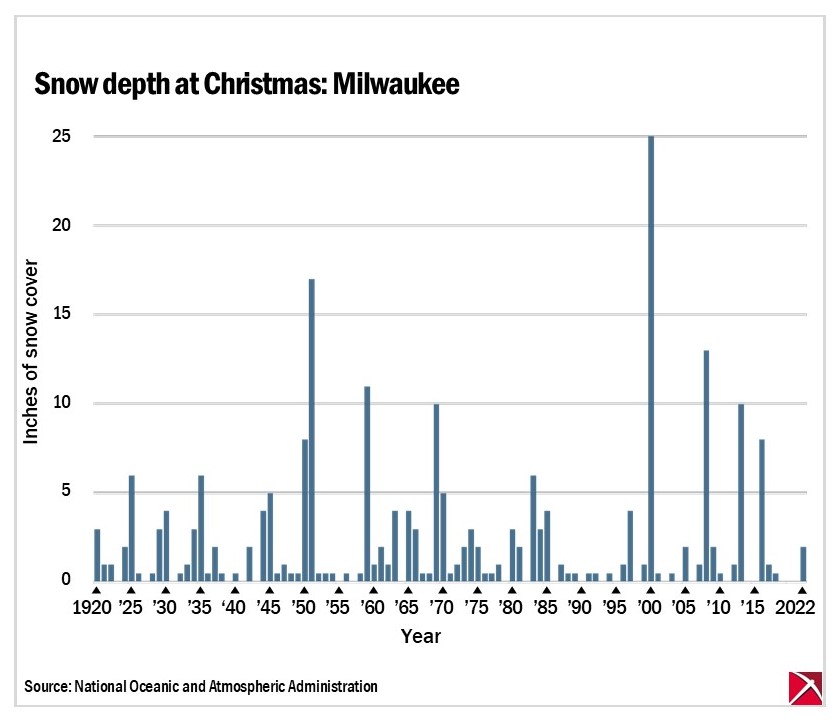
Dreaming of a white Christmas? Your odds are better if you live up north than in Milwaukee.
But even in Milwaukee, in any given year, there’s a good chance of at least some snow accumulation, and the average Milwaukee snow cover at Christmas is greater in recent years than during some other long stretches in the past century, according to records from the National Oceanic and Atmospheric Administration, the agency that includes the National Weather Service. |
|
|
When it comes to Christmas, you gotta love little cities like Abbotsford. And you gotta love huge metropolises like New York. Both, in the spirit of the season, allow Christmas tree sellers to operate without charge or regulation.
No permits. No fees. No problem. They’re showing a little faith and trust in the goodness of mankind — and the marketplace. |
|
|
Weekly Survey: Is Die Hard a Christmas movie? |
|
|
Invest in the Badger Institute |
|
|
The Badger Institute, formerly known as the Wisconsin Policy Research Institute (WPRI), has long been at the forefront of the fight for school choice, right to work, welfare reform, tax restructuring, limited government, civil society and so much more. If you appreciate the Institute’s legacy and want to support free markets, opportunity and prosperity, please consider donating today. Your support will help the Institute continue to advocate for conservative principles now and in generations to come.
|
| |
|
The Institute never has, and never will, accept government funding. We gratefully welcome your online donation or email Angela Smith, Executive Vice President.
The Badger Institute is a 501(c)(3) tax-exempt nonprofit organization funded solely by the generosity of foundations, companies and individuals. |
|
|
Badger Institute
700 W. Virginia St., Suite 301
Milwaukee, WI 53204 |
|
|
|