
Email
Children Deserve More than Shutdown Threats and Continuing Resolutions*
| From | Eugene Steuerle & The Government We Deserve <[email protected]> |
| Subject | Children Deserve More than Shutdown Threats and Continuing Resolutions* |
| Date | November 20, 2023 2:26 PM |
Links have been removed from this email. Learn more in the FAQ.
Links have been removed from this email. Learn more in the FAQ.
View this post on the web at [link removed]
The House and Senate passed a bill to keep the federal government funded through early next year. This avoids a shut down and all the costs that entails. But it also leans on a set of “continuing resolutions”, which essentially tell government agencies to do what they have been doing. Bypassing the regular budget process [ [link removed] ] this way allows policymakers to avoid tough decisions about which programs deserve more resources and which will get less. And when this happens, children are often among the biggest losers.
When Congress adopts stopgap funding measures to avoid a shutdown and provide more time for negotiations, the discretionary programs [ [link removed] ] requiring annual or regular appropriations are lucky to maintain spending at “current” levels, defined as past total spending or spending per capita.
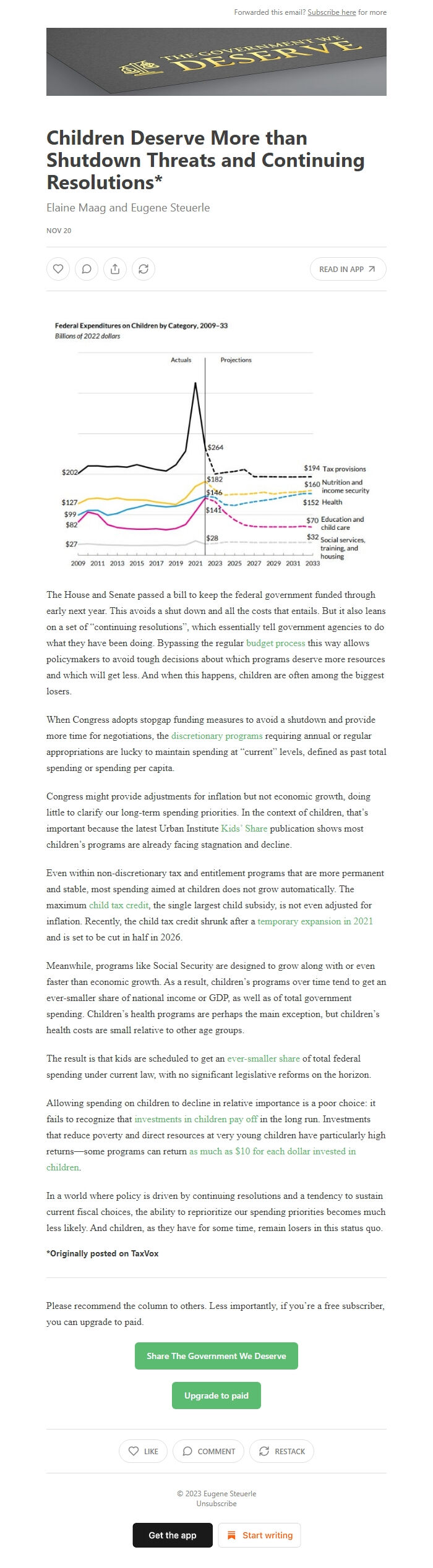
Congress might provide adjustments for inflation but not economic growth, doing little to clarify our long-term spending priorities. In the context of children, that’s important because the latest Urban Institute Kids’ Share [ [link removed] ] publication shows most children’s programs are already facing stagnation and decline.
Even within non-discretionary tax and entitlement programs that are more permanent and stable, most spending aimed at children does not grow automatically. The maximum child tax credit [ [link removed] ], the single largest child subsidy, is not even adjusted for inflation. Recently, the child tax credit shrunk after a temporary expansion in 2021 [ [link removed] ] and is set to be cut in half in 2026.
Meanwhile, programs like Social Security are designed to grow along with or even faster than economic growth. As a result, children’s programs over time tend to get an ever-smaller share of national income or GDP, as well as of total government spending. Children’s health programs are perhaps the main exception, but children’s health costs are small relative to other age groups.
The result is that kids are scheduled to get an ever-smaller share [ [link removed] ] of total federal spending under current law, with no significant legislative reforms on the horizon.
Allowing spending on children to decline in relative importance is a poor choice: it fails to recognize that investments in children pay off [ [link removed] ] in the long run. Investments that reduce poverty and direct resources at very young children have particularly high returns—some programs can return as much as $10 for each dollar invested in children [ [link removed] ].
In a world where policy is driven by continuing resolutions and a tendency to sustain current fiscal choices, the ability to reprioritize our spending priorities becomes much less likely. And children, as they have for some time, remain losers in this status quo.
*Originally posted on TaxVox
Unsubscribe [link removed]?
The House and Senate passed a bill to keep the federal government funded through early next year. This avoids a shut down and all the costs that entails. But it also leans on a set of “continuing resolutions”, which essentially tell government agencies to do what they have been doing. Bypassing the regular budget process [ [link removed] ] this way allows policymakers to avoid tough decisions about which programs deserve more resources and which will get less. And when this happens, children are often among the biggest losers.
When Congress adopts stopgap funding measures to avoid a shutdown and provide more time for negotiations, the discretionary programs [ [link removed] ] requiring annual or regular appropriations are lucky to maintain spending at “current” levels, defined as past total spending or spending per capita.
Congress might provide adjustments for inflation but not economic growth, doing little to clarify our long-term spending priorities. In the context of children, that’s important because the latest Urban Institute Kids’ Share [ [link removed] ] publication shows most children’s programs are already facing stagnation and decline.
Even within non-discretionary tax and entitlement programs that are more permanent and stable, most spending aimed at children does not grow automatically. The maximum child tax credit [ [link removed] ], the single largest child subsidy, is not even adjusted for inflation. Recently, the child tax credit shrunk after a temporary expansion in 2021 [ [link removed] ] and is set to be cut in half in 2026.
Meanwhile, programs like Social Security are designed to grow along with or even faster than economic growth. As a result, children’s programs over time tend to get an ever-smaller share of national income or GDP, as well as of total government spending. Children’s health programs are perhaps the main exception, but children’s health costs are small relative to other age groups.
The result is that kids are scheduled to get an ever-smaller share [ [link removed] ] of total federal spending under current law, with no significant legislative reforms on the horizon.
Allowing spending on children to decline in relative importance is a poor choice: it fails to recognize that investments in children pay off [ [link removed] ] in the long run. Investments that reduce poverty and direct resources at very young children have particularly high returns—some programs can return as much as $10 for each dollar invested in children [ [link removed] ].
In a world where policy is driven by continuing resolutions and a tendency to sustain current fiscal choices, the ability to reprioritize our spending priorities becomes much less likely. And children, as they have for some time, remain losers in this status quo.
*Originally posted on TaxVox
Unsubscribe [link removed]?
Message Analysis
- Sender: n/a
- Political Party: n/a
- Country: n/a
- State/Locality: n/a
- Office: n/a