| Know better. Do better. |  | Climate.
Change.News from the ground, in a warming world |
|
| | Hunt for new donors heats upThe cupboard may not be bare when it comes to climate finance, but there are many different cupboards - and those who are the hungriest often don't have the keys.
This was borne out by the Green Climate Fund's third pledging conference last week, where the world's biggest multilateral climate fund fell short of garnering the $10 billion it secured in the first two pledging rounds in 2014 and 2019. Despite growing demand from its main clients - vulnerable developing nations - for finance to adopt clean energy and adapt to extreme weather and rising seas, promises this time totalled just $9.3 billion.
The GCF's new executive director, Mafalda Duarte, told Context it wants to work with more local organisations and simplify access to its resources to enable finance to flow to vulnerable people "that haven't really been reached".  Farmers carry harvested rice at a paddy
field following the effects of the worsening drought due to failed rain seasons, in Mwea, Kenya November 30, 2022. REUTERS/Thomas Mukoya |
After the pledging session - which saw the biggest contributions largely from European countries and Japan - the German hosts and the GCF said they are confident other rich nations, including the U.S. and Australia, will step up with more money in the next few weeks before the COP28 climate conference in Dubai.
Germany also specifically appealed to China and the Gulf states - such as COP28 host UAE - to join the international pool of climate finance donors. Whether they will do so is unclear, and could cause sparks to fly in Dubai, where there will be heated discussions around sources of finance for the new loss and damage fund eagerly awaited there.
This week, meanwhile, will see discussions rumble on at the annual meetings of the World Bank and International Monetary Fund in Morocco about how development finance institutions can do a better job at supporting efforts by debt-strapped vulnerable nations to pursue a low-carbon transition.
Here's one idea from a former top World Bank energy official on creating a new finance facility to invest in global public goods like reducing planet-heating emissions. 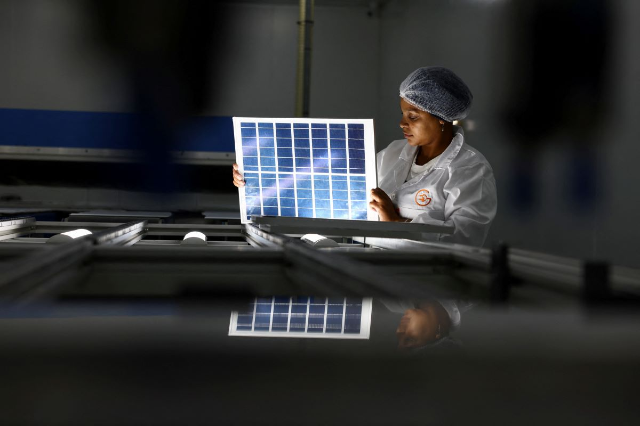 A woman looks at a solar panel, at a factory called Ener-G-Africa, where high-quality solar panels made
by an all-women team are produced, in Cape Town, South Africa, February 9, 2023. REUTERS/Esa Alexander |
Philanthropic push for ‘just transition’It's becoming clear that not all aspects of the urgently needed global green shift will be born equal.
For example, when it comes to the multi-billion-dollar Just Energy Transition Partnerships (JETPs) that have been announced for South Africa, Indonesia, Vietnam and Senegal - backed by wealthy governments and banks - the loans they're mainly offering are best suited for substituting fossil fuel production and power plants with renewables like solar and wind.
That has begged the question for some time now about who's going to take care of the "just" part of these deals - and make sure communities get a say in the dramatic changes that will affect their lives as well as a share of the benefits gained from cleaning up their countries' energy mix.
Step forward philanthropists with deep pockets: last month the IKEA Foundation and ClimateWorks Foundation announced a four-year, $20-million programme to help make JETPs in Indonesia, South Africa and Vietnam fair for workers and bring local opportunities. They have also invited other charitable organisations to put in more.
"This initiative is a seed that we're hopeful will grow into other regions of the world," said Jason Anderson of ClimateWorks Foundation. 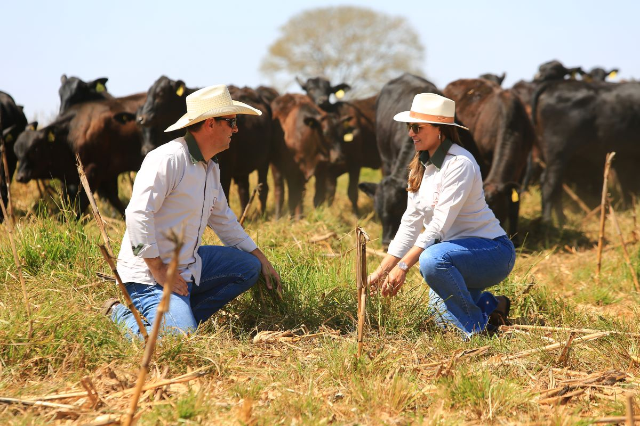 Ricardo Santinoni and his partner Fernanda Ferreira inspect the soil at Fazenda Morro do Peão, in Pires do Rio, Brazil, August 8, 2023. Thomson Reuters Foundation/Wildes Barbosa |
Can soy be sustainable - and profitable?And talking of seeds, the latest instalment in our
"Rerooted" series on the future of food in a warming world explores how soy could be grown without causing the environmental destruction that made it infamous in Brazil's Amazon region.
Our correspondent Fabio Teixeira travelled to the central state of Goiás in the lesser-known but vast Cerrado savanna to report on efforts to cultivate soy in a more sustainable way by using depleted land that has been regenerated.
There he met Brazilian farmer Ricardo Santinoni who explained how when he first planted soybeans, he could only afford to sow about 70 hectares, but two decades on, he has 1,000 - and he did it without cutting down a single tree.
Interestingly, investors are also spotting opportunities. Brazil's government has announced plans to create a fund for land restoration, aiming to gather about $120 billion from the private sector, while financial services firm Paramis Capital is structuring a 500-million reais ($100 million) fund to buy up degraded land and restore it in partnership with agricultural asset manager Fisalis.
"It's like buying an old house, renovating it and selling it," said Ricardo Scaff, an agricultural engineer and partner at Fisalis.
Do get in touch with innovative examples of finance for climate action!
Megan |
|
|