|
 |
A Hot Front in the US-China War
The horrific attacks this weekend in Israel have explosive escalation potential
|

| |||||||||||||||


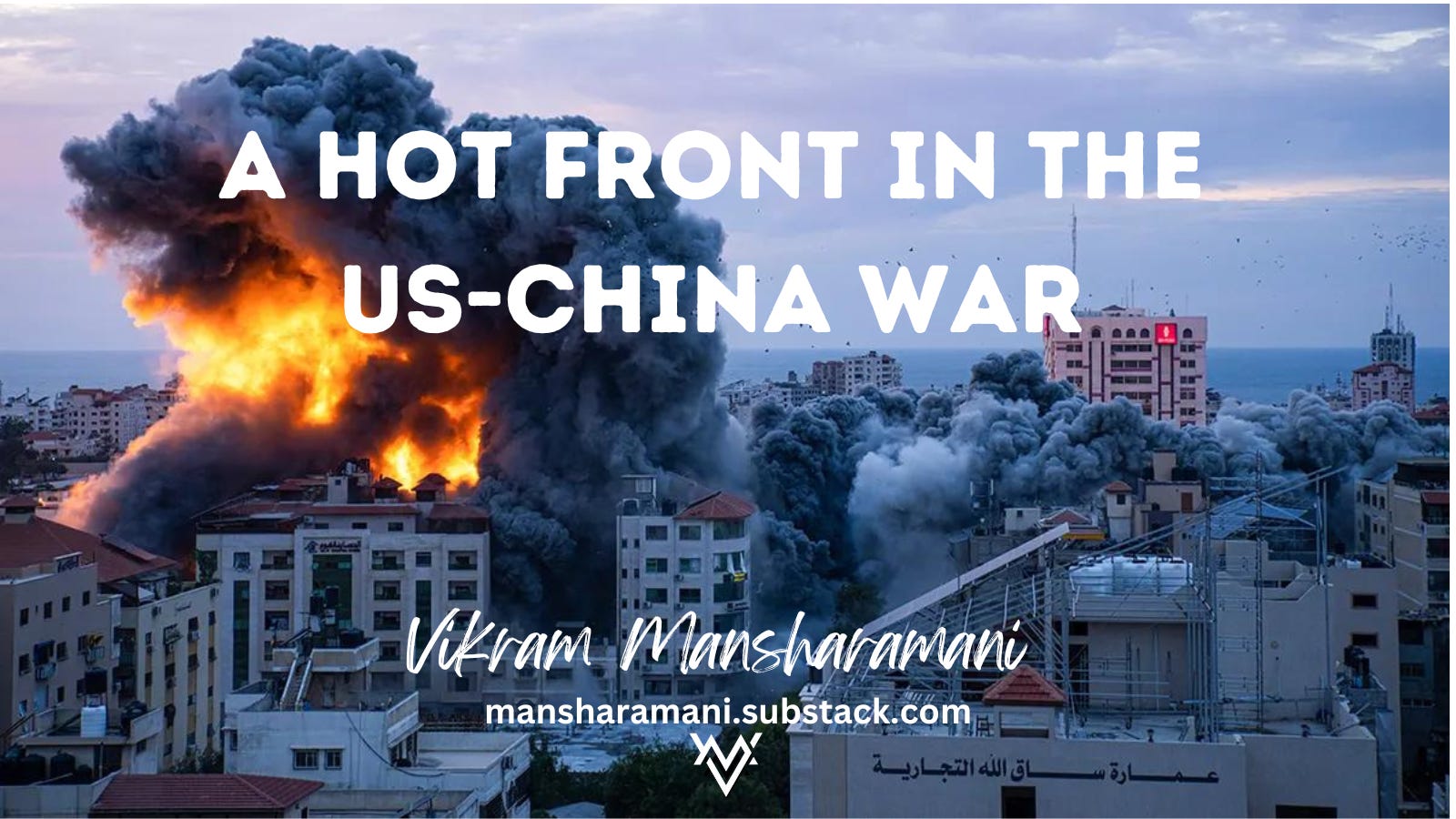 |
The brazen terrorist attacks on Israel over the weekend by Iran-linked Hamas are another sign the world is splitting into two rival ecosystems, one led by the United States (and its Western allies) and the other led by an increasingly visible China-Russia-Iran-North Korea (CRINK) alliance.
Hamas soldiers entered Israel from Gaza via land, air, and sea as rockets flew overhead. The Israeli Defense Force (IDF) said more than 2,000 rockets were fired while Hamas claimed the number was 5,000. (CNN noted that ~4,000 rockets were fired from Gaza into Israel during the 50 day war in 2014). Disturbing stories have emerged of Hamas taking hundreds of hostages and of the slaughter of hundreds of innocent people at a music festival. On Sunday evening, it was reported that Iran had provided planning and other assistance to Hamas, providing final approval and support at a meeting in Beirut last week.
Many analysts believe a contributing factor around the timing of the attack was the possibility of normalized relations between Israel and Saudi Arabia, something the United States has been seeking for months and had hoped to wrap up by year end, before the US Presidential election season confused negotiation dynamics. Israel’s improving relationships with the UAE, Bahrain, and Morocco (via the Abraham Accords) was evidence of diplomatic momentum that Iran sought to disrupt. As noted by the New York Times, “Hamas, Hezbollah and Iran are all opposed to any normalization with Israel” and early reactions to the attack from Saudi Arabia were not reflective of warming relations between the Kingdom and Israel:
On Saturday, after the Hamas assault, the Saudi Foreign Ministry released a statement that did not explicitly denounce the attack and instead laid the blame on Israel, saying that the Saudi government had repeatedly warned “of the dangers of the explosion of the situation as a result of the continued occupation, the deprivation of the Palestinian people and their legitimate rights and the repetition of systemic provocations against its sanctities.”
And it wasn’t just the reaction of Saudi Arabia that caught my attention. More than 30 Harvard student groups claimed Israel was “entirely responsible” for the Hamas attacks and expressed solidarity with Palestine. Russia called for ending the violence, urged a ceasefire, and encouraged a comprehensive negotiation process…but stopped short of condemning Hamas. Iran, of course, defended Hamas, noting that the attacks were a “spontaneous movement of resistance groups and Palestine's oppressed people in defence of their inalienable rights and their natural reaction to the Zionists' warmongering and provocative policies.” But perhaps most revealing to me was the statement from Beijing:
The statement was delivered shortly before US Senator Chuck Schumer (along with US senators Mike Crapo, Bill Cassidy, Maggie Hassan, John Kennedy, and Jon Ossoff) met with Chinese President Xi Jinping in Beijing. Schumer publicly stated his disappointment with the statement: “I urge you and the Chinese people to stand with the Israeli people and condemn these cowardly and vicious attacks…I was very disappointed, to be honest, by the foreign ministry’s statement that showed no sympathy or support for Israel during these troubled times.”
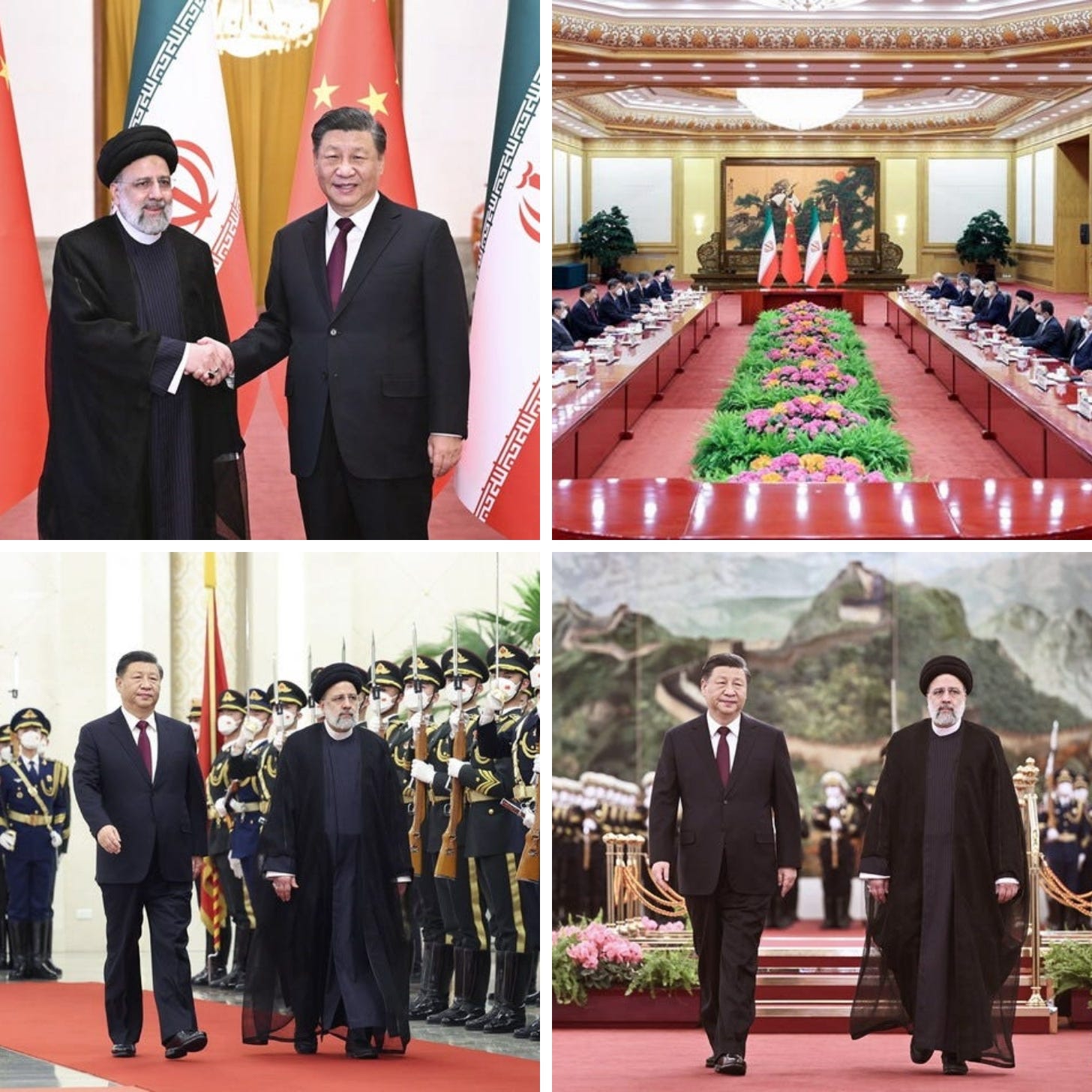
While I have long been concerned that Iran represents a grave threat to American interests abroad, as well as the overall stability of the Middle East, the rapidly deepening ties between Beijing and Tehran point to a new front in the US-China War. Consider the following developments in the past few years:
In early 2021, China and Iran signed a 25-year cooperation agreement to strengthen their political and economic relationship. Chinese Foreign Minister Wang Yi noted that “Relations between the two countries have now reached the level of strategic partnership….” US President Biden expressed concern about the emerging Iran-China relationship, leading the Secretary of Iran’s National Security Council to tweet “Biden's concern is correct: the flourishing of strategic cooperation in the East is accelerating the US decline.”
In late 2022, the Iranian Finance Minister announced 16 new memoranda of understanding with China as part of the 25-year comprehensive strategic partnership. The two countries signed deals in the energy, investment, banking, and infrastructure sectors, according to the US Institute of Peace.
In February 2023, during Iranian President Ebrahim Raisi's three-day state visit to China, 20 agreements were announced in which Beijing and Tehran would work together in the fields of “crisis management, tourism, communication and information technology, environment, international trade, intellectual property, agriculture, export, healthcare, media, sports and cultural heritage.” Xi and Raisi pledged cooperation on many matters, including security, and the ceremony ended with a 21 gun salute in Tiananmen Square amidst an overtly military display.
In March 2023, Beijing brokered a deal by which Iran and Saudi Arabia restored diplomatic ties, seven years after severing them, and agreed to open their embassies in Riyadh and Tehran.
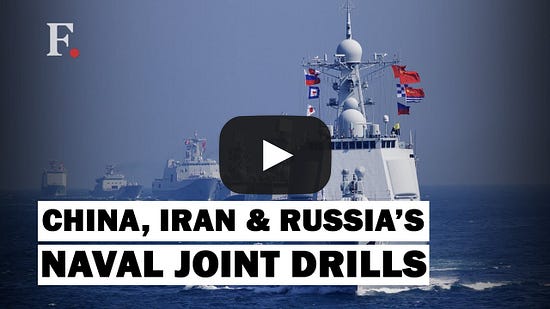
In March 2023, Iran joined Chinese and Russian forces for “Security Bond-2023,” a naval exercise that took place in the Gulf of Oman, following up on similar joint military activities that took place in 2019 and 2022.
So What?
This new front in the US-China War raises lots of questions and points to several concerning dynamics that might play out in the weeks and months ahead. And while we can never perfectly predict how the future will unfold, it’s worth considering some potential ramifications that can impact the world in which we live.
The Yom Kippur War of 1973, which took place almost 50 years ago to the day, was a hot front in the Cold War as the United States backed Israel and the USSR supported Arab nations. Might a similar dynamic be unfolding today? Is the war raging today a hot front of the US-China War, one in which America will back Israel as China (via Iran) backs Hamas? Are we in a proxy war that lends itself to rapid escalation if Iran directly attacks Israel?
Will the rapidly escalating war between the US and China force countries to pick sides as the world splits into two global systems? Many countries have sought American military guarantees while retaining the ability to conduct business with American adversaries. Will the desire for Chinese investments and the appeal of Chinese hydrocarbon markets be stronger than security concerns? Is this conflict the ultimate nail in the coffin of global multilateralism?
How might recent events impact the war in Ukraine? America’s ammunition stockpiles are already at historic lows, and US sentiment is increasingly “fatigued” as Ukraine calls for additional American support. At the same time, the US-Israel alliance appears rock solid. Might America divert limited military resources to Israel instead of Ukraine? Is the CRINK alliance draining the US arsenal of democracy? America is probably less able to support Taiwan.
Could Israel view Iran as an existential threat and attack their enrichment facilities? Or might America resort to blockades to prevent tankers from exporting Iranian oil to global markets to starve the Islamic regime of resources? How would China react to such developments? Or might the world decide Israel’s reaction was too severe and accuse the country of conducting a genocide against the people of Palestine? Could this degrade America’s moral standing in the world?
As the Chinese and American economies slow, demand for oil will likely fall…but the recent conflict implies that supply concerns will be more important. And if oil prices rise and stay higher for longer, will the resulting inflation lead to a rethink of American energy policies? How will the Federal Reserve respond to inflation bleeding into the prices of everyday goods? Might climate change efforts be halted (or reversed) if the stagflation grips the global economy?
 |
One lesson that may emerge from this new front of the US China war is that internal division may distract from external threats that produce existential vulnerabilities. Let’s not forget that Israel was deeply divided over a domestic debate about its Supreme Court’s powers, a controversy that spilled into civil unrest, military disobedience, and legal appeals. Might this internal dissent have been interpreted as potential weakness by the Hamas-Iran-China alliance? Or could the recent release of $6bn in seized funds have emboldened (and enabled) Tehran to confront American allies? Is American weakness destabilizing the world?
In the early 1990s, I had an opportunity to study ancient Chinese military strategy and how it was influencing military modernization and strategy in the People’s Republic of China. Consider the fifth of China’s famous Thirty-Six Strategms:
Loot a burning house (趁火打劫, Chèn huǒ dǎ jié)
In conclusion, what might the Chinese “Loot a Burning House” strategy mean for the United States? Given US challenges of governance, a highly polarized population, and the upcoming presidential election, is America’s ability to fend off external threats up for the challenge of an increasingly aggressive China?
About Vikram Mansharamani
Dr. Mansharamani is a global generalist who tries to look beyond the short term view that tends to dominate today’s agenda. He spends his time speaking with leaders in business, government, academia, and journalism…and prides himself on voraciously consuming a wide variety of books, magazines, articles, TV shows, and podcasts. LinkedIn twice listed him as their #1 Top Voice for Global Economics and Worthprofiled him on their list of the 100 Most Powerful People in Global Finance. He has taught at Yale and Harvard and has a PhD and two masters degrees from MIT. He is also the author of THINK FOR YOURSELF: Restoring Common Sense in an Age of Experts and Artificial Intelligence as well as BOOMBUSTOLOGY: Spotting Financial Bubbles Before They Burst. Follow him on Twitter or LinkedIn.
Invite your friends and earn rewards
| ||||||||||