| Know better. Do better. |  | Climate.
Change.News from the ground, in a warming world |
|
| | "Vast fortune"Former U.S. President Donald Trump denounced the Green Climate Fund (GCF) as costing the United States a wasteful “vast fortune” when he announced in 2017 that he was pulling out of the Paris climate agreement.
“Nobody is even close; most of them haven't even paid anything,” Trump said dismissively of the contributions by other nations, compared with $1 billion handed over under former President Barack Obama to help developing nations cut emissions and cope with impacts from floods to heatwaves.
Trump’s remarks irked France, Germany, Japan and Britain which had also pledged at least $1 billion each, and many other developed nations that were more generous per capita than the United States.
On Thursday, the GCF - again supported by the United States which rejoined the Paris Agreement under President Joe Biden - is seeking a new shot in the arm at a pledging conference in Bonn. Under Biden, the United States has provided another $1 billion, leaving unpaid one-third of its original $3-billion pledge made in 2014, which Obama failed to get past Congress.
Are rich nations willing to step up with the cash when many face pressure to spend it at home? The Fund's executive director, Mafalda Duarte, wants the GCF to manage $50 billion by 2030, against current capital of $17 billion. We’ll bring you more on her new vision later this week.
At a Climate Ambition Summit in New York last month, fresh pledges came from nations including France (1.61 billion euros) and Spain (225 million euros), while Britain has previously offered $2 billion. 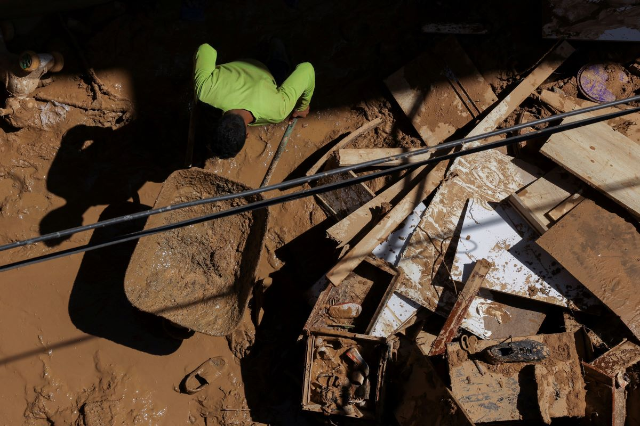 A person moves mud off a house that was impacted by fatal floods in Derna, Libya, September 19, 2023. REUTERS/Amr Alfiky |
“Adaptation apartheid”In Libya, deadly floods underscored how developing nations desperately need more funds to
combat climate change and overcome an “adaptation apartheid” that prevents politically weak states from accessing finance.
Storm Daniel triggered flooding last month that swept away parts of the coastal city of Derna, killing thousands of people and displacing tens of thousands more after heavy rains caused the collapse of two dilapidated dams.
Read the analysis by our correspondents Fahmi Igwianan and Nazih Osseiran, highlighting how ageing infrastructure adds to risks.
Ciaran Donnelly, a senior vice president for international programmes at the International Rescue Committee, said fragile states such as Yemen and Somalia that lack a strong public sector are unable to access and use climate cash.
"They'll get further behind," Donnelly said. "It really becomes a kind of self-reinforcing, vicious cycle." 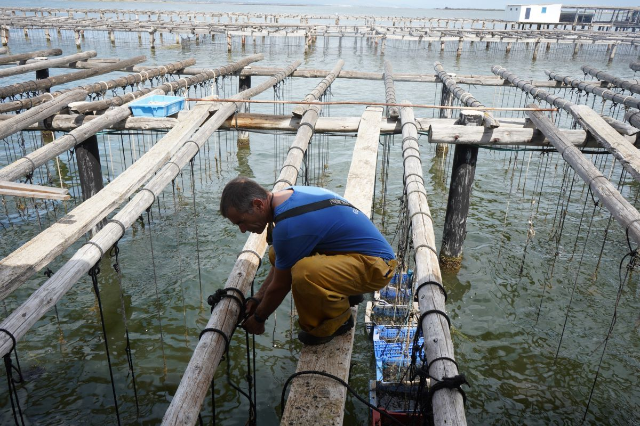 Xavier Cabrera unties ropes that would have been used to grow next year’s harvest of mussels in Catalunya, Spain, September 1, 2023. It takes about 14 months for mussels to grow to the desired size, but
a heatwave at the end of August killed about 80% of the mussel seed. Thomson Reuters Foundation/Naomi Mihara |
Mussels boiled at seaOn the other side of the Mediterranean, Spanish mussel farmers are lamenting a summer marine heatwave that killed off most of the harvest in the Ebro Delta south of Barcelona.
Farmer Xavier Cabrera has been removing empty shells of dead mussels dangling from 1,500 ropes in the waters where they would usually grow before harvest - for use in dishes such as seafood paella.
Similar high temperatures are a risk for farmers from Greece to Canada, and the options – such as farming in deeper, cooler waters – are often impossible because of the difficulty of getting permits to work further offshore.
European Union mussel production peaked in the late 1990s at more than 600,000 tonnes. In 2020, it had fallen to about 431,000 tonnes due to factors including global warming.
"This has gone from being a black goldmine to pure subsistence," Cabrera told our correspondents Natalie Donback and Naomi Mihara. |
Green jobs boomStill, it’s not all gloom.
The number of people working in renewable energy has nearly doubled in 10 years as the world shifts from polluting fossil fuels led by coal, oil and gas.
Jobs in renewable energies hit 13.7 million in 2022, including in solar, bioenergy, hydropower and wind, according to a new report by the International Renewable Energy Agency and the International Labour Organization.
Read our correspondent Jack Graham's explainer about how to get these jobs, what skills you need and how much they pay. Greening the global economy will be centre stage at COP28 in Dubai in November and December - testing how to enable a just transition that threatens the economies of fossil fuel producers.
Enjoy the week and please get in touch with ideas!
Alister |
|
|