|  | Know better. Do better. |  | Climate.
Change.News from the ground, in a warming world |
|
| | Root cause of the climate crisisThe G20 summit in India this weekend drew the climate action battle lines largely as expected - between those who want to expand clean energy while continuing to use fossil fuels, and those who want to focus on tackling the root of the problem by phasing out climate-heating coal, oil and gas.
For now, it's the former camp that is winning. After some pushback by oil producers and big emerging economies - the latter on the hunt for more financial support - the group of the world's 20 richest countries set a goal of tripling global renewable energy capacity by 2030, calling for an energy transition that is "sustainable", "inclusive" and "just".
They reiterated a year-old promise for a "phase down" of highly polluting coal power (China and India are the world's top coal consumers) but shunned a bolder "phase out" favoured by many developed nations - and stopped short of setting a goal aimed at ending the use of fossil fuels.
This division between nations and businesses that want to demonstrate their green energy prowess while quietly extracting and burning the bad stuff, and those prepared to fight on both fronts, will play out in the coming months - from the anti-fossil fuel street protests planned for this coming weekend to the September 20 Climate Ambition Summit at the UN, and December's COP28 climate talks hosted by the oil- and gas-rich United Arab Emirates.
"While the G20's commitment to renewable energy targets is commendable, it sidesteps the root cause - our global dependency on fossil fuels," said Harjeet Singh, head of global political strategy at Climate Action Network International, an alliance of green groups from 130 countries. "As the climate crisis looms like a dark cloud over humanity, the world cries out for a just transition away from fossil fuels."  A man decorate a hoarding with flowers on a pavement ahead of
the G20 Summit in New Delhi, India, September 8, 2023. REUTERS/Amit Dave |
Africa adaptation 'oversight'Fossil fuels were also the elephant in the room at the inaugural Africa Climate Summit in Nairobi last week - where government and U.N. leaders sought to promote the continent as a source of solutions to global warming, rooted in its rich natural resources from sunshine to forests.
At the same time, they were keen to stress the need for more climate finance to turn that potential into the reality of a green and fair transition, through support for proposals such as global carbon taxes, reform of development finance institutions and building carbon markets. 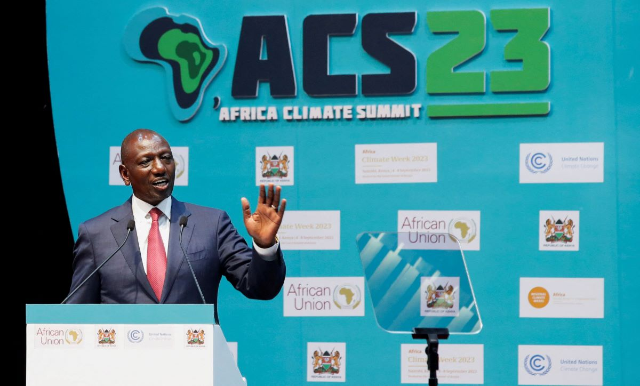 Kenya's President William Ruto addresses delegates at the close of the Africa Climate Summit (ACS) 2023 at the Kenyatta International Convention Centre (KICC) in Nairobi, Kenya, September 6, 2023. REUTERS/Monicah Mwangi |
"We must see in green growth not just a climate imperative, but also a fountain of multi-billion-dollar economic opportunities that Africa and the world is primed to capitalise," Kenyan President William Ruto told the summit.
Activists, meanwhile, said the region's aspirations to transition its energy supplies are challenged by funding for fossil fuels by governments and investors, with ActionAid highlighting how banks worldwide gave $3.2 trillion to the fossil fuel industry in Global South countries in the seven years since the 2015 Paris climate agreement.
Other experts pointed to the summit's scant attention to Africa’s huge need to adapt to climate change impacts, with veteran U.N. climate scientist Debra Roberts of South Africa telling our correspondent Alister Doyle it was a "chronic oversight".
As confirmed by a key U.N. progress report late last week, the world is off track for the Paris Agreement goal to limit global warming to 1.5C - something Roberts said African leaders had failed to acknowledge, even as they face floods, drought, biodiversity loss and disease.
"A world of (1.5C) overshoot for Africa is a disastrous place, a place of existential crisis," she warned in an interview.  People are stuck on a road as a powerful storm and heavy rainfall hit Shahhat city, Libya, September 11, 2023. Picture taken with a drone. REUTERS/Ali
Al-Saadi |
Mosquitoes on the moveAs the planet sweltered through its hottest three-month period on record from June to August, the consequences of failing to keep a lid on rising temperatures have been shockingly evident. This week has seen yet more devastation, with over 2,000 people dead in Libya where Storm Daniel has caused devastating floods after rampaging through Greece and Turkey.
In South Asia, meanwhile, the effects of warming temperatures have shown up in crowded medical facilities in Bangladesh and Nepal, where authorities are struggling to cope with surging cases of the mosquito-borne disease dengue - also known as "breakbone fever" for the severe muscle and joint pains it induces. 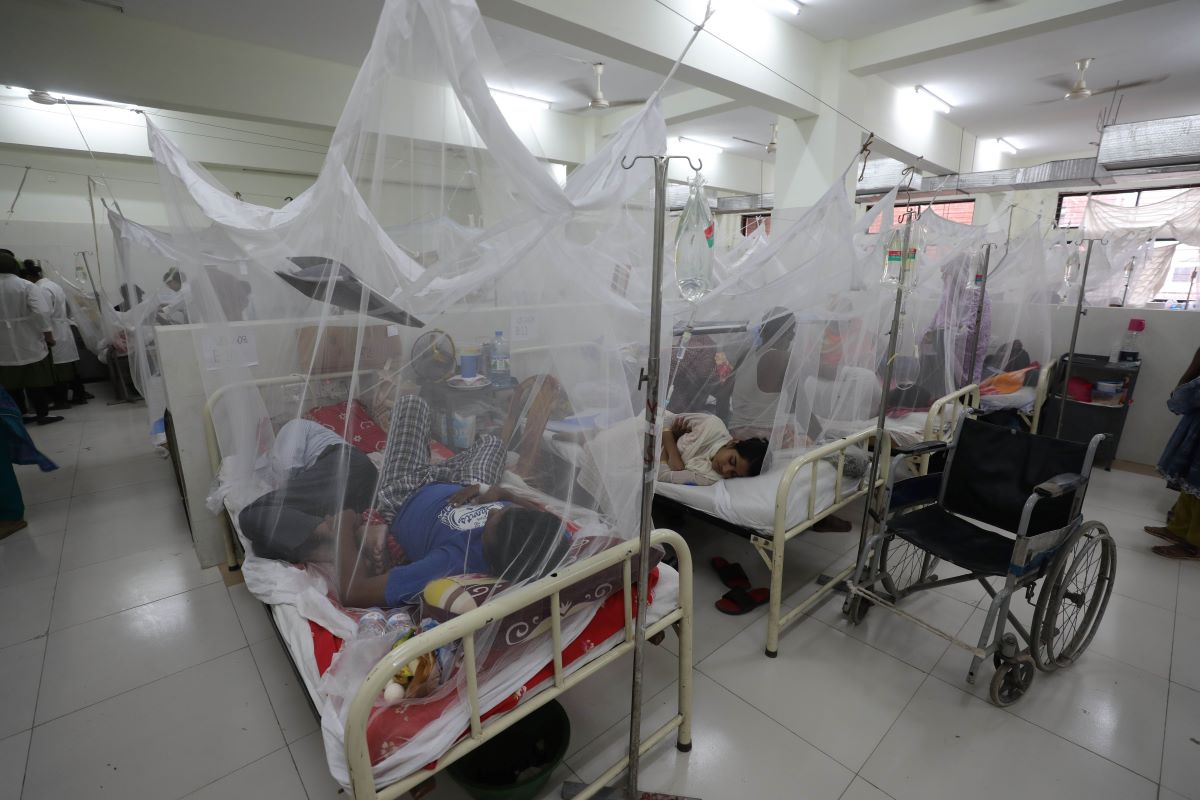resize.jpg/640w) Dengue patients are protected with mosquito nets inside the dengue wards at the Shaheed Suhrawardy Medical College, Dhaka, August 30, 2023, Thomson Reuters Foundation/Mosabber
Hossain |
Entomologists and epidemiologists told our reporters on the ground that rising temperatures and longer monsoon seasons are providing ideal breeding conditions for mosquitoes - a key factor in the jump in dengue cases.
Dengue rates are also rising globally with 4.2 million cases reported in 2022, up eight-fold from 2000, according to the World Health Organization, which has warned it's the fastest-spreading tropical disease worldwide and represents a "pandemic threat".
Yet another reason for policymakers to step up efforts to tackle the already troubling effects of global warming without further delay.
See you next week,
Megan |
|
| | G20 countries set a goal of tripling renewable energy but fall short of ambition needed to limit global warming to 1.5C | Leaders at the Africa Climate Summit highlight the continent’s huge renewable energy potential, but say far more finance is needed | At the Africa Climate Summit (ACS), the
continent's leaders underestimated the risks of warming, says scientist Debra Roberts | One green group is raising awareness about the importance of mangroves and other forests among young urbanites, with events from fun runs to concerts | The media today gives little space to anti-science views, but new narratives have emerged aimed at slowing the
green transition | Africa Climate Summit is a chance to spur medical innovation to combat neglected climate-sensitive diseases | |
| | | | | | |
|