|
 |


 |
Reading the text of former Vice President Mike Pence’s speech this week challenging Republicans to choose between populism and conservatism, I was reminded of a scene from the series “Breaking Bad.” Fans of the show will recall the unforgettable story Mike Ehrmantraut related to Walter White from his days as a Philadelphia cop. I won’t repeat the whole story here, as that part is mostly irrelevant. What really matters is how he ended it: “Moral of the story is I chose a half measure when I should have gone all the way. I'll never make that mistake again.” Unfortunately, I fear Mike Pence is choosing a half measure again.
While I cheer the content of Pence’s speech, he should have delivered it seven years ago, when the Republican Party experienced its true 21st-century “time for choosing.” Now, it’s an anachronism. The GOP already made its choice. Pence, like so many others from the pre-Trump Republican Party, chose a half measure—making the mildest of criticisms of Trump (if that) while publicly supporting, enabling, and normalizing him. What they failed to recognize, or perhaps simply didn’t care enough to notice, was that demagoguery has a way of metastasizing. And it can’t easily be put back in the bottle once it’s released.
I’d like to think the “full measure” Mike Pence of January 6, 2021, is the guy who’s running for president in 2024. But I’m not confident of that. At all. At the recent GOP debate, when the candidates were asked if they would support Trump as the party’s nominee—even if he is convicted of one of the many crimes with which he is now charged—Pence raised his hand. Half measures. Unlike Mike Ehrmantraut, Mike Pence may indeed make that mistake again. —Melissa Amour, Editor, Democracy Defender
 |
 |
Look who’s back
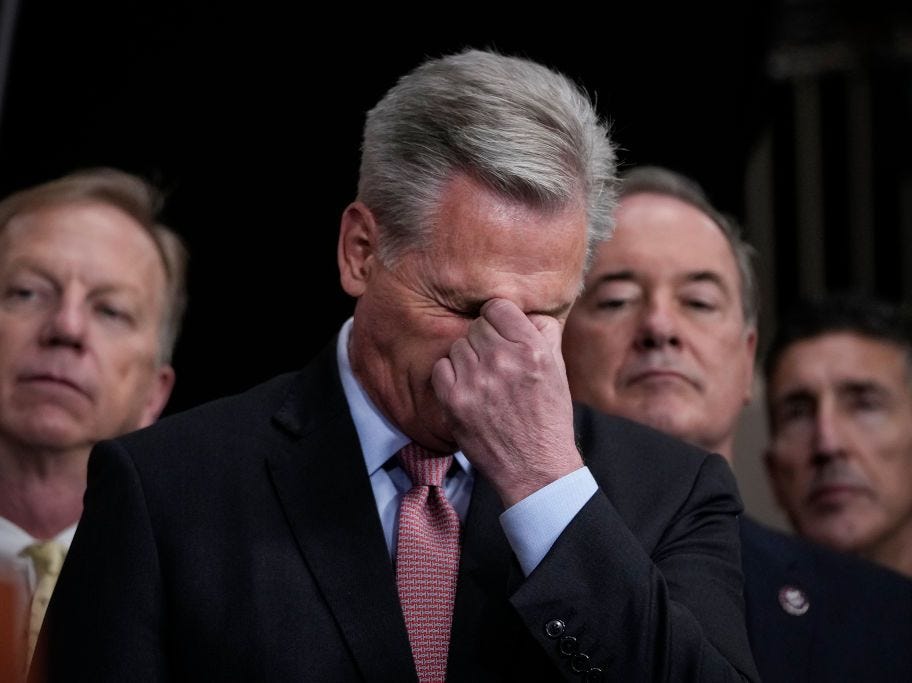
Lawmakers returned to Capitol Hill this week, and they already have a big challenge on their hands: avert a government shutdown. The House is scheduled to meet for just 11 days before the government’s fiscal year ends on Sept. 30, meaning they’ll have to reach a deal quickly to keep the government funded. MAGA extremists are openly embracing the idea of a government shutdown. The House Freedom Caucus has released a list of far-right demands it wants included in order to vote for the continuing resolution. With Republicans holding just a five-seat majority in the House, MAGA extremists have significant leverage over the agenda.
MAGA Rep. Marjorie Taylor Greene is demanding an impeachment inquiry in return for her vote. At a town hall meeting, she said: “I will not vote to fund the government unless we have passed an impeachment inquiry on Biden….[The] Biden regime’s weaponized government,” COVID vaccines, and Ukraine’s defense against the Russian invasion…“I will not fund those things.” Once again, MAGA extremists are obstructing and bullying—not governing in good faith. Rather than using the tried and true democratic tools of negotiation and compromise, they dig in, double down, and domineer, putting the best interests of the country on the back burner.
Even Senate Republicans don’t want to impeach Joe Biden —The Independent
Sen. McConnell’s health episodes show no evidence of strokes or seizures, Capitol physician says —Associated Press
Rep. Nancy Pelosi announces she’s running for reelection —NPR
Former Rep. Bill Richardson, champion of Americans held overseas, dies at 75 —The New York Times
The courts punch back
Two southern states caught up in a contested redistricting process have been rebuked by the courts—again—and their maps have been deemed racially unjust. A Florida redistricting plan advanced by Gov. Ron DeSantis violates the state constitution, a state judge ruled on Saturday. The map is prohibited from being used for any future U.S. congressional elections since it diminishes the ability of Black voters in north Florida to pick a representative of their choice.
A federal court blocked a newly-drawn Alabama congressional map on Tuesday because it didn’t create a second majority-Black district, as the Supreme Court had ordered earlier this year. “We are deeply troubled that the State enacted a map that the State readily admits does not provide the remedy we said federal law requires,” the three judges, two of whom were appointed by Donald Trump, wrote. While it’s certainly good news that the courts are standing up for the rights of people of color, it remains disturbing that the redistricting process is being used to undermine the power of minority votes. Further, the states’ reckless indifference to prior court rulings—including the U.S. Supreme Court in the case of Alabama—shows a disregard for the separation of powers and the basic functioning of democracy under the American system.
Disinformation is still out there
It’s not talked about as often as it was a few years ago, but disinformation is not only still around, it’s growing. Meta just took down a sprawling network of fake accounts linked to Chinese law enforcement in what the social media company called “the largest known cross-platform covert influence operation in the world.” As part of China’s efforts to expand into the information warfare space dominated by Russia and Iran, the influence operation targeted at least 50 platforms, including YouTube, Reddit, Pinterest, TikTok, Medium, and X/Twitter, with posts praising China’s policies, denigrating U.S. and Western foreign policy, and attacking journalists and researchers critical of the Chinese government.
Complicating matters is the integration of AI, which is helping to smooth out awkward grammatical errors, cultural differences, and other oddities that reveal posts to be obviously inorganic. With 2024 fast approaching, expect others to jump into the disinformation game again. The 2016 and 2020 elections showed how powerful foreign and domestic disinfo can be. Better tech tools will make it even more difficult to defend against in a presidential election year.
Musk’s changes at Twitter helped spread Russian propaganda, EU study finds —The Washington Post
Here’s what else happened this week:
Neo-Nazi and white supremacist groups spread hate outside Disney World —I24NEWS
Ken Paxton impeachment trial draws tears as former employees testify in Texas —NBC News
Special counsel to indict president’s son this month, Justice Department says —CNN
Ukrainian counteroffensive making ‘tangible progress’: Blinken —NBC News
Biden aims to woo back allies with Putin, Xi absent from G-20 Summit —Bloomberg
 |
 |
One more thing…
More courtroom action in Trumpworld this week. Special Counsel Jack Smith said in a court filing on Tuesday that Donald Trump has made “daily extrajudicial statements that threaten to prejudice the jury pool” in the 2020 election subversion case. Meanwhile, two of Trump’s co-defendants in the Georgia racketeering case—attorneys Kenneth Chesebro and Sidney Powell—lost their bid to sever their charges. Fulton County Superior Court Judge Scott McAfee ruled that he didn’t find it necessary to achieve a fair trial. They will, however, get the speedy trial they requested beginning on Oct. 23. McAfee added that he is doubtful that the remaining 17 defendants could be tried together, as District Attorney Fani Willis has requested.
Another Georgia co-defendant, former White House Chief of Staff Mark Meadows, lost his quest to have his case tried in federal court, rather than in Fulton County. He’ll likely appeal the decision, setting up a potential U.S. Supreme Court case down the line. Meadows may have some company—Trump on Thursday formally notified the judge overseeing the case that he “may” try to move his state case into federal court as well.
Mar-a-Lago IT worker strikes deal to flip on Trump —The Daily Beast
Special counsel election probe continues with focus on fundraising, voting equipment breaches —CNN
Peter Navarro convicted of contempt of Congress over Jan. 6 subpoena —The New York Times
Trump suffers another legal loss to E. Jean Carroll, as judge rules he defamed her as president —Politico
 |
Two cheers for hope
United by AI? There may be at least one issue that our congressional representatives find common ground on—the threat of artificial intelligence. On Capitol Hill, a bipartisan group that includes Senate Majority Leader Chuck Schumer and Sen. Martin Heinrich (both Democrats) and Sens. Todd Young and Mike Rounds (both Republicans) have been meeting almost weekly since the spring, racing to formulate rules that protect Americans from AI’s worst threats, such as biological weapons and mass unemployment—but also promote the technology’s potential to cure diseases and curb hunger. —Bloomberg
Yes, it can be done. Gerry Leonard, a Republican who has spoken out against Donald Trump in the past, has won the GOP primary for Rhode Island’s special election for the 1st Congressional District. Leonard, a Marine veteran and political newcomer, defeated fellow Republican Terri Flynn by more than 50 percentage points on Tuesday. The special election is being held after former Democratic Rep. David Cicilline stepped down in the summer to lead the Rhode Island Foundation. —Newsweek
It’s nice to get reminders that, at its best, government can still work for the public interest. Share a story of hope from your community for a future issue of Democracy Defender. Please include your name and state with your submission. Thank you!
 |
 |
Democracy holds us together
“The unalienable rights of life, liberty, and the pursuit of happiness, as stated in the Declaration of Independence, are principles that bind us together as Americans. They have enabled the United States to strive toward a more perfect union, even when we have not always lived up to those ideals.
As a diverse nation of people with different backgrounds and beliefs, democracy holds us together. We are a country rooted in the rule of law, where the protection of the rights of all people is paramount. At the same time, we live among our fellow citizens, underscoring the importance of compassion, tolerance, pluralism, and respect for others.
We, the undersigned, represent a wide range of views across a breadth of issues. We recognize that these views can exist peaceably side by side when rooted in the principles of democracy. Debate and disagreement are central features in a healthy democracy. Civility and respect in political discourse, whether in an election year or otherwise, are essential.” —Joint Statement from 13 Presidential Centers, September 7, 2023
If you received this issue of Democracy Defender by email, it’s because you subscribed to it on Substack, signed up to receive mailings from Mission: Democracy, or have an awesome friend who forwarded it to you (make sure to thank them🙂).
We want to hear from you! Let us know what we’re doing right—or wrong. Send your feedback to Melissa Amour, Editor, at [email protected]. Thank you for defending American democracy!
Democracy Defender is the weekly newsletter of Mission: Democracy, a political action committee founded to defend democracy against extremists in Congress. To learn more about Mission: Democracy, please visit our website at www.missiondemocracy.org.
| ||||||||||