
| From | Michigan DNR <[email protected]> |
| Subject | NotMISpecies webinars: Real-world invasives solutions |
| Date | July 11, 2023 1:11 PM |
Links have been removed from this email. Learn more in the FAQ.
Links have been removed from this email. Learn more in the FAQ.
Register now for these upcoming programs
Share or view as webpage [ [link removed] ]? |? Update preferences [ [link removed] ]
Michigan Invasive Species Program banner [ [link removed] ]
"News Release"
July 11, 2023
Contact:?Joanne Foreman <[email protected]>,?517-243-6450
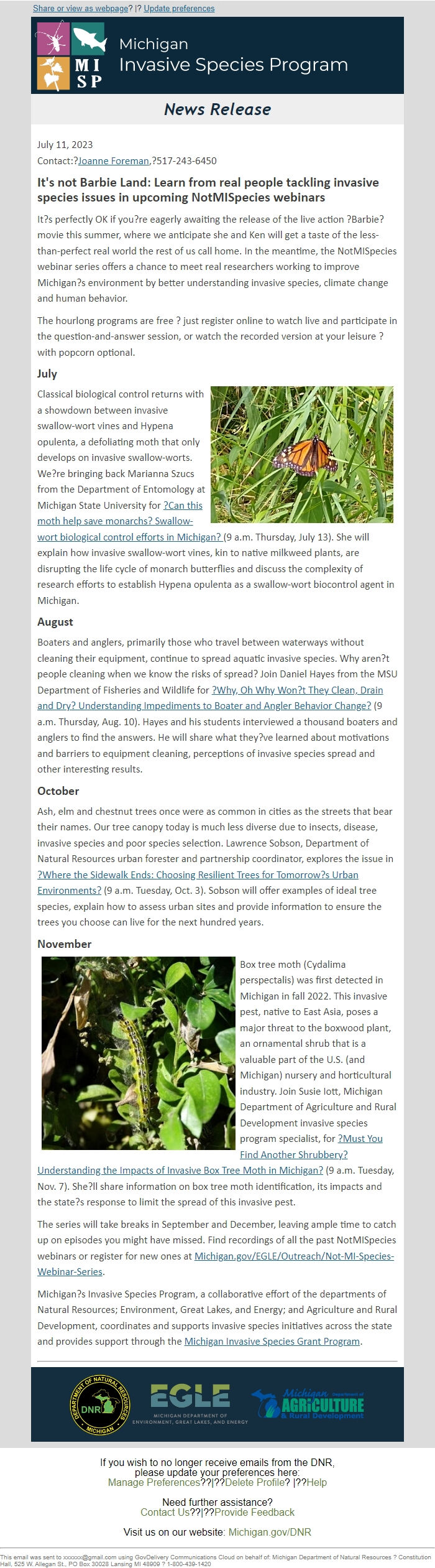
It's not Barbie Land: Learn from real people tackling invasive species issues in upcoming NotMISpecies webinars
It?s perfectly OK if you?re eagerly awaiting the release of the live action ?Barbie? movie this summer, where we anticipate she and Ken will get a taste of the less-than-perfect real world the rest of us call home. In the meantime, the NotMISpecies webinar series offers a chance to meet real researchers working to improve Michigan?s environment by better understanding invasive species, climate change and human behavior.
The hourlong programs are free ? just register online to watch live and participate in the question-and-answer session, or watch the recorded version at your leisure ? with popcorn optional.
July
A monarch butterfly resting on a swallow-wort plant amidst tall grass.
Classical biological control returns with a showdown between invasive swallow-wort vines and Hypena opulenta, a defoliating moth that only develops on invasive swallow-worts. We?re bringing back Marianna Szucs from the Department of Entomology at Michigan State University for ?Can this moth help save monarchs? Swallow-wort biological control efforts in Michigan? [ [link removed] ](9 a.m. Thursday, July 13). She will explain how invasive swallow-wort vines, kin to native milkweed plants, are disrupting the life cycle of monarch butterflies and discuss the complexity of research efforts to establish Hypena opulenta as a swallow-wort biocontrol agent in Michigan.
August
Boaters and anglers, primarily those who travel between waterways without cleaning their equipment, continue to spread aquatic invasive species. Why aren?t people cleaning when we know the risks of spread? Join Daniel Hayes from the MSU Department of Fisheries and Wildlife for ?Why, Oh Why Won?t They Clean, Drain and Dry? Understanding Impediments to Boater and Angler Behavior Change? [ [link removed] ] (9 a.m. Thursday, Aug. 10). Hayes and his students interviewed a thousand boaters and anglers to find the answers. He will share what they?ve learned about motivations and barriers to equipment cleaning, perceptions of invasive species spread and other interesting results.
October
Ash, elm and chestnut trees once were as common in cities as the streets that bear their names. Our tree canopy today is much less diverse due to insects, disease, invasive species and poor species selection. Lawrence Sobson, Department of Natural Resources urban forester and partnership coordinator, explores the issue in ?Where the Sidewalk Ends: Choosing Resilient Trees for Tomorrow?s Urban Environments? [ [link removed] ] (9 a.m. Tuesday, Oct. 3). Sobson will offer examples of ideal tree species, explain how to assess urban sites and provide information to ensure the trees you choose can live for the next hundred years.
November
A green and yellow box tree moth caterpillar stretches across box tree leaves.
Box tree moth (Cydalima perspectalis) was first detected in Michigan in fall 2022. This invasive pest, native to East Asia, poses a major threat to the boxwood plant, an ornamental shrub that is a valuable part of the U.S. (and Michigan) nursery and horticultural industry. Join Susie Iott, Michigan Department of Agriculture and Rural Development invasive species program specialist, for ?Must You Find Another Shrubbery? Understanding the Impacts of Invasive Box Tree Moth in Michigan? [ [link removed] ] (9 a.m. Tuesday, Nov. 7). She?ll share information on box tree moth identification, its impacts and the state?s response to limit the spread of this invasive pest.
The series will take breaks in September and December, leaving ample time to catch up on episodes you might have missed. Find recordings of all the past NotMISpecies webinars or register for new ones at Michigan.gov/EGLE/Outreach/Not-MI-Species-Webinar-Series [ [link removed] ].
Michigan?s Invasive Species Program, a collaborative effort of the departments of Natural Resources; Environment, Great Lakes, and Energy; and Agriculture and Rural Development, coordinates and supports invasive species initiatives across the state and provides support through the Michigan Invasive Species Grant Program [ [link removed] ].
________________________________________________________________________
DNR Logo 24 bit PNGDept of Environment, Great Lakes and Energy logoMDARD Logo
If you wish to no longer receive emails from the DNR,
please update your preferences here:
Manage Preferences [ [link removed]? ]??|??Delete Profile [ [link removed] ]? |??Help [ [link removed] ]
Need further assistance?
Contact Us [ [link removed] ]??|??Provide Feedback <[email protected]>
Visit us on our website: Michigan.gov/DNR [ [link removed] ]
________________________________________________________________________
This email was sent to [email protected] using GovDelivery Communications Cloud on behalf of: Michigan Department of Natural Resources ? Constitution Hall, 525 W. Allegan St., PO Box 30028 Lansing MI 48909 ? 1-800-439-1420
Share or view as webpage [ [link removed] ]? |? Update preferences [ [link removed] ]
Michigan Invasive Species Program banner [ [link removed] ]
"News Release"
July 11, 2023
Contact:?Joanne Foreman <[email protected]>,?517-243-6450
It's not Barbie Land: Learn from real people tackling invasive species issues in upcoming NotMISpecies webinars
It?s perfectly OK if you?re eagerly awaiting the release of the live action ?Barbie? movie this summer, where we anticipate she and Ken will get a taste of the less-than-perfect real world the rest of us call home. In the meantime, the NotMISpecies webinar series offers a chance to meet real researchers working to improve Michigan?s environment by better understanding invasive species, climate change and human behavior.
The hourlong programs are free ? just register online to watch live and participate in the question-and-answer session, or watch the recorded version at your leisure ? with popcorn optional.
July
A monarch butterfly resting on a swallow-wort plant amidst tall grass.
Classical biological control returns with a showdown between invasive swallow-wort vines and Hypena opulenta, a defoliating moth that only develops on invasive swallow-worts. We?re bringing back Marianna Szucs from the Department of Entomology at Michigan State University for ?Can this moth help save monarchs? Swallow-wort biological control efforts in Michigan? [ [link removed] ](9 a.m. Thursday, July 13). She will explain how invasive swallow-wort vines, kin to native milkweed plants, are disrupting the life cycle of monarch butterflies and discuss the complexity of research efforts to establish Hypena opulenta as a swallow-wort biocontrol agent in Michigan.
August
Boaters and anglers, primarily those who travel between waterways without cleaning their equipment, continue to spread aquatic invasive species. Why aren?t people cleaning when we know the risks of spread? Join Daniel Hayes from the MSU Department of Fisheries and Wildlife for ?Why, Oh Why Won?t They Clean, Drain and Dry? Understanding Impediments to Boater and Angler Behavior Change? [ [link removed] ] (9 a.m. Thursday, Aug. 10). Hayes and his students interviewed a thousand boaters and anglers to find the answers. He will share what they?ve learned about motivations and barriers to equipment cleaning, perceptions of invasive species spread and other interesting results.
October
Ash, elm and chestnut trees once were as common in cities as the streets that bear their names. Our tree canopy today is much less diverse due to insects, disease, invasive species and poor species selection. Lawrence Sobson, Department of Natural Resources urban forester and partnership coordinator, explores the issue in ?Where the Sidewalk Ends: Choosing Resilient Trees for Tomorrow?s Urban Environments? [ [link removed] ] (9 a.m. Tuesday, Oct. 3). Sobson will offer examples of ideal tree species, explain how to assess urban sites and provide information to ensure the trees you choose can live for the next hundred years.
November
A green and yellow box tree moth caterpillar stretches across box tree leaves.
Box tree moth (Cydalima perspectalis) was first detected in Michigan in fall 2022. This invasive pest, native to East Asia, poses a major threat to the boxwood plant, an ornamental shrub that is a valuable part of the U.S. (and Michigan) nursery and horticultural industry. Join Susie Iott, Michigan Department of Agriculture and Rural Development invasive species program specialist, for ?Must You Find Another Shrubbery? Understanding the Impacts of Invasive Box Tree Moth in Michigan? [ [link removed] ] (9 a.m. Tuesday, Nov. 7). She?ll share information on box tree moth identification, its impacts and the state?s response to limit the spread of this invasive pest.
The series will take breaks in September and December, leaving ample time to catch up on episodes you might have missed. Find recordings of all the past NotMISpecies webinars or register for new ones at Michigan.gov/EGLE/Outreach/Not-MI-Species-Webinar-Series [ [link removed] ].
Michigan?s Invasive Species Program, a collaborative effort of the departments of Natural Resources; Environment, Great Lakes, and Energy; and Agriculture and Rural Development, coordinates and supports invasive species initiatives across the state and provides support through the Michigan Invasive Species Grant Program [ [link removed] ].
________________________________________________________________________
DNR Logo 24 bit PNGDept of Environment, Great Lakes and Energy logoMDARD Logo
If you wish to no longer receive emails from the DNR,
please update your preferences here:
Manage Preferences [ [link removed]? ]??|??Delete Profile [ [link removed] ]? |??Help [ [link removed] ]
Need further assistance?
Contact Us [ [link removed] ]??|??Provide Feedback <[email protected]>
Visit us on our website: Michigan.gov/DNR [ [link removed] ]
________________________________________________________________________
This email was sent to [email protected] using GovDelivery Communications Cloud on behalf of: Michigan Department of Natural Resources ? Constitution Hall, 525 W. Allegan St., PO Box 30028 Lansing MI 48909 ? 1-800-439-1420
Message Analysis
- Sender: State of Michigan
- Political Party: n/a
- Country: United States
- State/Locality: MIchigan
- Office: n/a
-
Email Providers:
- govDelivery