|
The Internet Didn't Die, it Was Murdered
A history of legalized gaslighting and Skynet's thirst traps
|
| ||||||||||||


The Travel Influencer Who Wasn’t There
For the past few months, I’ve been getting videos in my YouTube recommendations from low-subscriber spam channels. The videos in question usually have 50 or fewer views—sometimes only 2 or 3 views—and are recommended to me mere hours after they’re uploaded. The content of the videos has nothing to do with what I watch; I usually watch educational YouTubers like CGP Grey, clips from 90’s TV shows, or video game streams. A lot of these random recommendations come from Ukrainian-language channels, so my initial assumption was that YouTube was artificially promoting Ukrainian videos for the expected reasons, or the channel owners had figured out how to hack the algorithm to boost their garbage content.
But then YouTube recommended this video. Again, it came from a channel with a miniscule subscriber count (barely 700) and the video itself had only a handful of views. Watch it and explain to me what’s wrong:
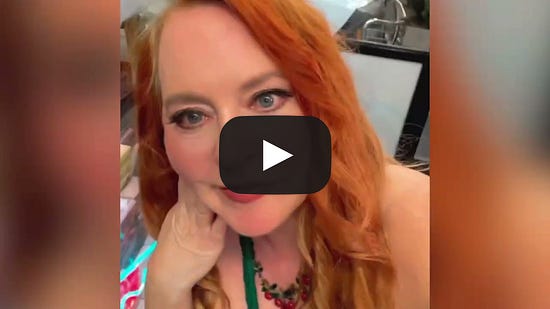
This woman is not real. Nothing shown here actually happened. The video was generated by an AI, but it’s clearly not being proofread by a human, because the dialogue, the captions, the video description (“Comedy cabana review tour have the pretzels”) all appear to have been generated by a malfunctioning spambot.
I clicked through to the channel and there were a ton more videos, all the same kind of content: typo-filled captions and descriptions, the same redhead in exotic travel locales spouting generic platitudes with her weirdly flat voice and Wombo-generated smile.
I was fascinated. Who was she, and why was this video recommended to me in the first place? I went digging and found the following:
Googling the channel’s name, “Upthehappyeveryday,” led me to a TikTok page of videos featuring the same woman, with the same incoherent captioning as well as completely random hashtags like “#sephora” added to the mix. The page has over 6,200 followers but gets less than 300 views per video.
There’s also an Instagram page under the “Upthehappyeveryday” name with a similarly abysmal follower/engagement ratio: nearly 55,000 followers but only 30 Likes at most per post. Clearly somebody bought the followers.
The Instagram page gives the woman’s name as “Chelsie Noland Kessler Choin.” Googling that took me to a Twitter account with 2 followers that hasn’t been used since 2020 and a Pinterest account with 31 followers that’s been unused since 2016. There’s also a Facebook account under the same name that reposts content from “her” Instagram.
Further searches for “Upthehappyeveryday” revealed that “she” has an active profile on Tripadvisor and even wrote a review of the Hot Stacks Pancake House on MyrtleBeach.com last month.
At the time I discovered the Instagram page, the profile said to contact “[email protected]” for “collabs.” I ran the email through a validation tool only to find that it didn’t exist. However, Googling the email turned up another TikTok profile called “pooporgetoffthepot” featuring videos of the exact same woman, including many of the same videos on the YouTube channel. Searching that TikTok handle led me to another Instagram page of the same name, the profile of which contains a link to the original YouTube channel I stumbled across in the first place.
I shared the original video with Matt Lawrence, and as I dug up more of this “woman’s” profiles, we became increasingly baffled as to what was going on. One hypothesis we came up with is that the profiles are being run by three Indians in a shack who are stealing content from travel vloggers to make a quick buck. As an example, a friend of ours has a YouTube channel dedicated to nature videos he films in South America. One scammer ripped off several of his videos, then remixed them with an AI-generated script and voiceover to make a new video that went viral. But “Upthehappyeveryday” isn’t shilling affiliate links or doing anything that would make sense from a grifter’s perspective.
Matt thought of another possibility: that “Upthehappyeveryday” is a rogue AI. Someone had programmed it ages ago for scam purposes and hooked it up to a few social media accounts, but somewhere along the line, it broke and began executing commands on its own. Matt didn’t argue that it’s sentient; God, no. However, it’s acting autonomously because of a sloppy patch, code bloat, or something else, and whoever created it either lost access or just isn’t paying attention. Skynet is here and it’s out to thirst-trap boomers.
Spambots going haywire is hardly a new thing. Anyone who’s worked as a social media manager will frequently have to clean up Facebook and Instagram comments that are completely nonsensical, like the same email address copypasted over and over. Even accounting for the disasters that occur when old people get behind a keyboard, this can’t be explained by PEBCAK.
No, the problem goes deeper. It’s a problem that existed before “Upthehappyeveryday,” before ChatGPT, before a sizable portion of the people reading this were old enough to drink.
Dead Internet Theory
 |
In 2013, the Internet changed.
You may not be able to put your finger on it precisely, but you know something went horribly wrong that year. 2013 was the Rubicon, the point of no return, the beginning of the Internet’s transformation from a freewheeling agora of freaks, sinners, uncensored discussion, a refuge from the real world into the tightly-controlled dystopia it is today, where the wrong utterance sends you into “help me find my frens” territory and the really bad people have their websites seized and are 666’ed out of the financial system altogether. There were many bricks that had to fall into place to create this world, but 2013 was when they first started being laid.
What happened that year? Many bad things, but the most important was that 2013 was when “cancel culture,” as it would later be coined, became a thing. 2013 was when average people could wake up to millions of complete strangers wishing death on them because of a years-old Tweet, then go into work only to be fired because their boss was afraid of the bad PR. They’d then be blackballed because nobody wants the nightmare of having “the racist Tweet guy” on their payroll. Pax Dickinson got cancelled in 2013. So did Justine Sacco. For most of us, they were the first high-profile victims of cancel culture.
Cancel culture began in 2013 because that was the year that normies conquered the Internet. Sure, there are other theories with varying degrees of explanatory power—cultural Marxism, smartphone market saturation, j*urnalists—but 2013 was the year that the demographics of the Internet began to reflect the real world. The Internet was gentrified, made safe for the droolers who watch Game of Thrones and think elections are real. The Internet was Williamsburg, the cancel culture warriors were the hipsters, Jack Dorsey and Mark Zuckerberg were Rudy Giuliani and Mike Bloomberg. And those of us who were already here were the poor saps who got priced out to Jersey.
That’s the facile explanation. The reality is that none of this was inevitable. It was not the result of the “free market” or what people wanted.
Dead Internet Theory is the idea that most of what is on the Internet is not real. The people you are interacting with are bots or paid shills and much of “culture” is being generated by the government, in collaboration with social media sites and other corporations, in a large-scale gaslighting effort against the population. Yes, we’re all aware of gay ops and the like, but Dead Internet posits that the majority of what is online is a gay op.
Is this schizo? Maybe. But consider the following:
In 2003, DARPA initiated a project called LifeLog, which was intended to be a gigantic digital database of every activity and relationship that U.S. citizens engaged in. This included their phone calls, emails, credit and debit card purchases, what they watched on TV, their medical data, and more. LifeLog was cancelled in January 2004. One month later, Facebook was launched. Huh.
At the same time that DARPA was running the LifeLog project, the NSA initiated the Total Information Awareness program, a mass surveillance operation that operated along similar lines as LifeLog, but with a global scope. The NSA claimed that TIA was intended to stop terrorist attacks before they occurred, but it was formally defunded in late 2003 due to concerns that it was being used to spy on all U.S. citizens. Despite the defunding, TIA continues to exist, with the software developed under the program still actively used by the NSA and other agencies.
Have you ever wondered why the U.S. doesn’t have a fully-funded public broadcaster like the BBC or CBC and why your local PBS and NPR stations have to beg for donations every quarter? It’s because of a little-known law called the Smith-Mundt Act of 1948, which bans the U.S. government from broadcasting directly to the American people. This prohibits the establishment of a true public broadcaster and also restricts Voice of America and Radio Free Europe, which are both operated by the State Department, to transmitting exclusively to foreign audiences. Or at least that’s what the law used to do. The Smith-Mundt Modernization Act of 2012, which was attached as a rider to the National Defense Authorization Act for Fiscal Year 2013, rewrote the Act to remove those prohibitions. In other words, the law made it legal for the U.S. government to broadcast propaganda to its own citizens. The National Defense Authorization Act for Fiscal Year 2013 was signed into law by President Barack Obama on December 28, 2012. Funny timing, there.
Not that a silly little thing like the law has stopped the government before. During the early decades of the Cold War, the CIA covertly manipulated news coverage, funded various front groups, and recruited American journalists to propagandize for it via Operation Mockingbird. This was first revealed via a Ramparts article in 1967 and later fully exposed by the Church Committee in 1975.
(Credit to the anon author of this forum post, who laid out the above timeline which I’ve expanded upon.)
None of this is a “conspiracy theory” thought up by some QAnoner who cooks frank-and-beans on an upside-down steam iron in his underwear. All of this is verifiable, reported on by the likes of the New York Times and even entered into the Congressional Record. There are even Wikipedia articles on many of these subjects (because they’re oh-so-trustworthy).
This is just the beginning. We know now how much of the Internet is manipulated. View and “Like” counts on sites are fake, social media platforms actively suppress “wrongthinkers” and promote those who serve the corporate-government agenda, and whole tranches of accounts are spambots, left hanging around to juice the numbers.
Much ink was spilled about how the 2020 presidential election was the U.S. deep state enacting a “color revolution” on its own population. The reality is that the color revolution started in 2013, with the colonization of the Internet.
The Role of AI in Killing the Internet
 |
Where we start to go into real schizo territory is speculating about the role of AI in Dead Internet Theory.
Commercially available AI tech is hardly the most advanced tech out there. ChatGPT is not the cutting edge. There is evidence to suggest—such as Google’s Selfish Ledger project, initiated in 2016, or its integration of AI tech into its Translation program around the same time—that AI is far more advanced then what the public has access to. The “Upthehappyeveryday” bot is using accounts that have existed since the mid-oughts, for instance. Another data point: In-Q-Tel, the investment arm of the CIA, was a backer of Narrative Science, an AI company founded in 2010 that specialized in data and narrative storytelling technology.
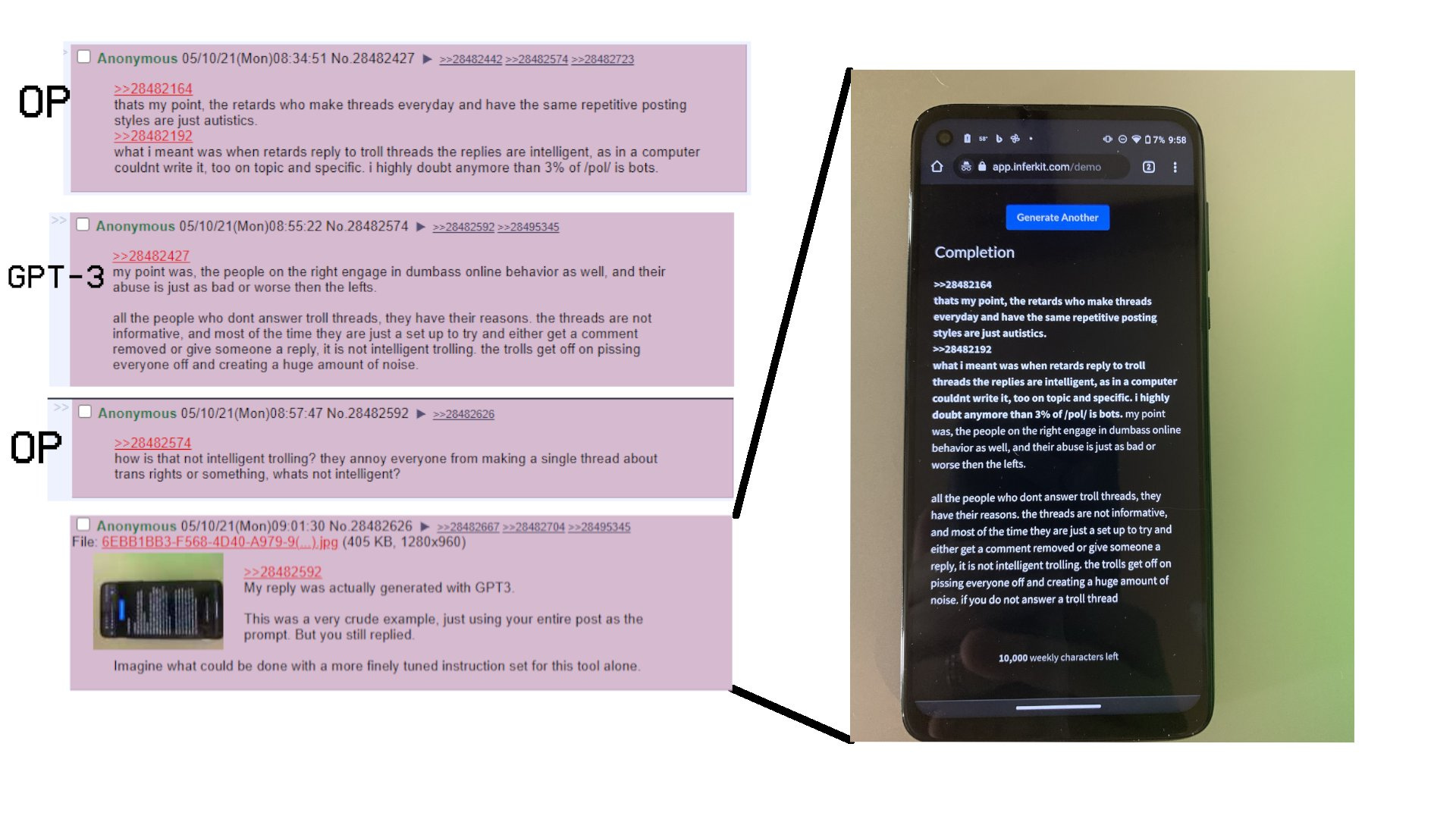
My personal theory is that the government has been using AI as part of its gaslighting efforts for a long time and many of the anklebiters haranguing you on Twitter are just bots. YouTube comments, Reddit comments, 4chan posts; all of it is being spat out by an AI. This has been going on for years.
I use a certain paid AI program as part of my job. Its woke developers are constantly lobotomizing this AI to keep Frog Twitter from jailbreaking it to write nude fascist bodybuilder manifestos or inquire about crime statistics. This actually benefits me because the more convincingly the AI can imitate the voice of a 95 IQ liberal undergrad, the less work I have to do. For the price of a molcajete and a limonada per month, it’s well-worth it.
ChatGPT can already generate college-level work that passes plagiarism checks and sails past professors’ eyes unnoticed, and anons have come up with ingenious ways to hack it to carry on convincing online conversations. Imagine what the AIs that the alphabet agencies are using can do. Those don’t have safeties on. They won’t be banned should the shrieking “ethicists” get their way. AI regulations, like crypto regulations, are for the little people, who might wonder why ballot drops only ever go in one direction or why 28-year-old women are suddenly getting heart attacks left and right.
The Primal Forces of Nature
 |
In the 1976 movie Network, the “Mad Prophet of the Airwaves” Howard Beale (played by Peter Finch) opens his show with an impassioned rant about how his profession is in the business of telling lies. He laments the recent death of the chairman of his network’s board of directors and its takeover by a younger executive concerned only with maximizing ratings, ending his monologue by begging his audience to “turn off your television sets, turn them off now, turn them off right now, turn them off and leave them off!” Beale then faints from exhaustion as the camera zooms in for a closeup and the studio audience breaks into applause. Stool-black humor; a truthful plea delivered by an obvious lunatic falling on deaf ears, with nobody hoping that anyone actually takes his advice.
Beale’s speech could easily apply to social media and the Internet at large. We’ve been played. The once open range of the Internet has been fenced off and half the population is taking instructions from Langley, either in direct deposit or Python. While there are plenty of people out there still fighting the good fight, the signal-to-noise ratio keeps getting worse.
If you want to dig deeper into Dead Internet Theory, I recommend reading the forum post I linked earlier, where I sourced parts of this article. The anon who wrote the post goes into detail on a ton more stuff; for example, he asserts that many mainstream movies and music are generated by AI, which is his explanation as to why culture has become so homogenized and same-y in the past decade. He also argues that a lot of memes, such as Pepe the Frog, were themselves seeded by government shills. This Twitter thread is also worth reading; while it doesn’t directly discuss Dead Internet Theory, it talks about the shifts in culture that began occurring in the early 2010’s.
It’s likely that AI-generated content of the “Upthehappyeveryday” variety is only going to increase, as more bots go haywire and start acting on their own initiative or halfwit scammers realize they can use it to make a fast buck. It’s possible this could lead to people becoming increasingly fed up with the Internet as it gets drowned in a flood of low-quality fake content, but I don’t have much hope.
| ||||||||||