Email not displaying correctly? VIEW IT in your browser. |
Dear Readers,
Between filing a federal lawsuit challenging Utah’s AVS mandate, leading our first-ever Washington D.C. fly-in event, and connecting with members in Miami, May was an exciting month for FSC.
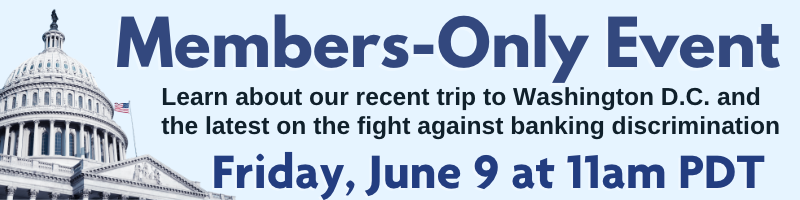
As you’ll read in Mike’s Public Affairs Report, the trip to Capitol Hill was a huge success! Members who want to learn more should be sure to check out our webinar on June 9th where we’ll share the details about how the trip went and our plans for building on the momentum we’ve created on this issue.
It was also a busy month for age verification policy. The number of US states with AVS requirements has grown to six – a development we certainly plan to challenge as we did in Utah.
Thank you, FSC members, for making all of this important work possible.
Have a great Memorial Day weekend!
Sincerely, |
Alison Boden
Executive Director, Free Speech Coalition |
|
|
AVS Redirect Pages
Since FSC launched DefendOnlinePrivacy.com last month, politicians in Utah and Louisiana have received hundreds of messages from their constituents expressing their dissatisfaction with age verification mandates!
Virginia and Mississippi’s laws go into effect July 1st, so we’ve added new pages for website owners who wish to redirect traffic from that state as well. It explains to users why they’re being blocked and encourages them to contact their legislators to express their displeasure with the law.
|
|
|
FSC Meets With Congress On Banking Discrimination
FSC is actively addressing the ongoing issue of financial discrimination faced by adult businesses. This week, FSC held multiple in-person meetings with members of Congress in Washington DC and organized a Congressional reception sponsored by Segpay. The goal is to raise awareness among legislators about the unfair banking practices targeting the adult industry. We emphasize the importance of being recognized as legitimate businesses deserving equal rights. Our previous lobbying efforts in December, along with the release of a report on financial discrimination in March, have laid the groundwork for these ongoing discussions. Executive Director, Alison Boden, Director of Public Affairs, Mike Stabile, and Board Treasurer, Cathy Beardsley are leading the delegation along with several other FSC members. Financial discrimination remains a significant challenge for adult businesses, and FSC is grateful for the support of its members in combating this issue.
|
|
|
Public Affairs Report
As Alison mentioned, we’ve been … busy. From the state age-verification laws to federal legislation like KOSA, EARN IT and STOP CSAM, we’re burning the candle at both ends. But we’re also going on the offense.
In May, FSC members from across the country flew to DC to meet with Congress to hopefully bring an end to financial discrimination for adult businesses. We met with fourteen Congressional offices — 9 in the Senate and 5 in the House — from across the political spectrum, and afterwards hosted a Congressional reception for staffers. Everyone we spoke with, even those who don’t like our industry, believed we had the right to fair banking.
We brought with us the new FSC Report on Banking Discrimination, and the data shocked those we met with. Among us were representatives from nearly every sector of the industry — including content creators, platform owners, payment processors, pleasure product retailers and sex worker activists — who spoke about how financial discrimination has harmed them.
We have a lot of work ahead of us. While every office was supportive, each had different possible solutions. We’re now working with members of Senate Banking and the House Financial Services to increase scrutiny on the banks, reign in discriminatory regulation, and advance bipartisan legislation that would guarantee banking for our businesses.
There’s a long road ahead, but we can do this. In fact, we should have done this a long time ago. The adult industry might think that we're too outside the political mainstream to have an effect, that no legislator wants to be seen as pro-porn (and that may be true), but our issues are universal issues, and the reception was overwhelmingly positive. Members can join us on June 9th to talk more about where we go from here.
Mike Stabile
FSC Director of Public Affairs
|
|
|
Legislative Updates
Age Verification:
- Legal Challenge: On May 3, FSC took a significant step by filing a lawsuit in federal court against Utah's unconstitutional age verification mandate.
- Virginia's New Law: On May 12, Virginia's age verification mandate was signed into law, set to take effect from July 1, 2023. To ensure everyone is well-informed, we have launched a dedicated landing page to educate users about the new regulations. Our efforts in Louisiana and Utah have already resulted in numerous messages sent to legislators.
- Montana: The bill in Montana has been sent for the Governor's signature on May 9. If approved, it will be implemented on January 1, 2024.
- Louisiana: Expected to pass this week, Louisiana's proposed update to their age verification law will grant the state attorney general the power to investigate adult websites without proper age verification. Websites failing to comply within 30 days may face fines. The effective date is projected to be August 1, 2023.
- New Bills: Alabama and North Carolina have recently introduced new bills addressing age verification.
Banking Fairness:
- Continuing the Fight: Our efforts to combat banking discrimination faced by the adult industry gained momentum during our recent visit to Washington D.C. The trip proved to be even more successful than our previous visit in December, reinforcing our commitment to achieving banking fairness for adult industry workers.
|
|
|
 |
Sex Workers Are The Unlikely Beneficiaries Of Twitter Blue
“'The entire world has changed,' says Michael Stabile, director of public affairs for the adult industry trade group the Free Speech Coalition. Print publications aren’t a feasible advertising option anymore, and most online ad markets (including Google and Facebook ads) explicitly ban advertising for even legal adult services." Read more on The Verge. |
Porn Industry Group Suing Utah 'Discussing' Response to Virginia's New Law
“The Free Speech Coalition has raised concerns over potential data leaks and scams if users must digitally transmit personal information to verify their age, pointing to reports of ‘potential identity theft’ incidents in Louisiana where a bill that mirrors Virginia’s has already gone into effect.” Read more on WFXR Fox. |
Alabama House Passes Bill Requiring Activated Porn Filters On Cellphones And Tablets
The Alabama House of Representatives has passed a bill mandating the activation of porn filters on cellphones and tablets. The bill aims to protect minors from accessing explicit content by requiring retailers to sell devices with pre-installed filters that block pornographic material. The filters can be deactivated by the device owner after providing proof of age. The bill received bipartisan support and is now headed to the Alabama Senate for further consideration. If passed, Alabama would join several other states with similar legislation. Read more on AL.com. |
Is the Tide Turning Against Internet Porn?
Utah's legislation requires that internet service providers (ISPs) block access to adult websites unless users specifically request to access them. As a result of this law, major ISPs have implemented blocking measures, significantly reducing traffic to Pornhub from Utah. Such measures infringe on individual freedom and raise concerns about censorship and overreach. The long-term effects of Utah's anti-pornography law and its implications for the adult industry, as well as broader debates surrounding internet regulation and personal liberties, continue to be subjects of ongoing discussion and scrutiny. Read more on Intelligencer. |
French Government Admits New Adult Content Law Will Target Twitter Too
The French Ministry of the Interior confirmed that the law's provisions, which require age verification for accessing adult content, will extend to Twitter as well. This development raises concerns about the practicality and feasibility of implementing age verification mechanisms on a platform like Twitter, which hosts a wide range of content. However, enforcing such measures on social media platforms could lead to privacy concerns, potential censorship, and challenges in distinguishing between adult and non-adult content. The French government's acknowledgment of including Twitter under the scope of the law adds to the ongoing debate surrounding regulation of adult content online and the balancing of interests such as freedom of expression and protection of minors. Read more on XBIZ. |
Rolling Stone Surveys Ongoing Republican War On Porn
The survey highlights the conservative movement's efforts to enact legislation aimed at curbing adult content and its potential impact on the industry. It examines various bills proposed by Republican lawmakers at the state and federal levels, including measures targeting age verification, restrictions on online adult content, and the potential labeling of pornography as a public health crisis. The survey reveals a divide among Republicans, with some advocating for stricter regulations based on moral and religious grounds, while others express concerns about the unintended consequences, such as potential infringement on free speech and the efficacy of proposed measures. Read more on XBIZ. |
Indiana Republicans Defund Kinsey Institute
Indiana Republicans' defunded the Kinsey Institute, a renowned research organization focused on human sexuality based at Indiana University. The decision was made as part of the state's budget bill, with Republican lawmakers expressing concerns about the institute's research methods and the perceived promotion of values they disagree with. The defunding action sparked criticism from advocates who argue that the Kinsey Institute plays a crucial role in advancing knowledge and understanding in the field of sexuality. Read more on XBIZ. |
Supreme Court Upholds Section 230 For Social Media Platforms
A recent Supreme Court decision has been made upholding Section 230 of the Communications Decency Act, which grants legal protections to social media platforms and other online intermediaries. The court ruled in favor of protecting social media platforms from liability for user-generated content. The case involved a challenge to the immunity provided by Section 230, arguing that it should be narrowed or eliminated due to concerns about platforms allowing harmful or objectionable content. However, the Supreme Court reaffirmed the importance of Section 230 in promoting free speech and enabling online platforms to moderate and curate content without fear of legal repercussions. The decision is seen as a significant victory for social media platforms and internet companies, as it provides continued legal protection and supports their role as intermediaries for user-generated content. Read more on XBIZ. |
The Free Speech Coalition: A Glimpse Into History
Did you know that FSC has a rich history dating back to 1968? Back then, adult entertainment was largely illegal, and those who defied the ban faced arrests and imprisonment. FSC's roots can be traced back to an early convention of theater owners held in Los Angeles. Over the years, FSC has fought numerous legal battles to protect the rights of adult entertainment workers and the industry as a whole. From landmark court victories to successfully defeating harmful legislation, FSC has been at the forefront of protecting freedom of speech and expression. |
Newsletter Feedback and Schedule
As I'm sure many of you have noticed, we've changed up our newsletter! The recipient list has remained the same but the style and frequency has changed.
Our new schedule has been changed to every other Friday. We would love to hear your feedback, concerns and suggestions on this change! |
|
|
FSC PO Box 10480, Canoga Park, CA 91309 Unsubscribe - Unsubscribe Preferences |
|
|
|
|
|